The Transformative Power of Uttanasana: Navigating Modern Stress Through the Ancient Practice of Standing Forward Bend

In an era dominated by relentless digital connectivity, fast-paced work environments, and systemic daily pressures, modern society frequently exposes individuals to micro-confrontations that accumulate over time. When human physical and mental systems lack the adequate tools to process these persistent stressors, a biological and psychological contraction occurs. This chronic tension manifests mentally, emotionally, and physically, gradually distorting an individual’s baseline perception of reality. Over extended periods, much like the imperceptible progression of the aging process, this state of contraction becomes so deeply normalized that simple corrective measures cease to be effective. However, somatic disciplines rooted in ancient traditions offer a structured methodology to confront and reverse these physiological distortions, transforming physical discomfort into an engine for personal growth and nervous system regulation.
The Roots of Somatic Confrontation in Yoga Archives
To understand how physical postures address modern psychological strain, wellness historians and practitioners frequently turn to foundational texts preserved in archival literature. Documenting practices that date back decades—and drawing from yoga lineages formalized globally since 1975—instructors have long emphasized that physical rigidity is rarely just a localized muscular issue. Instead, it serves as a physical archive of emotional and environmental resistance.
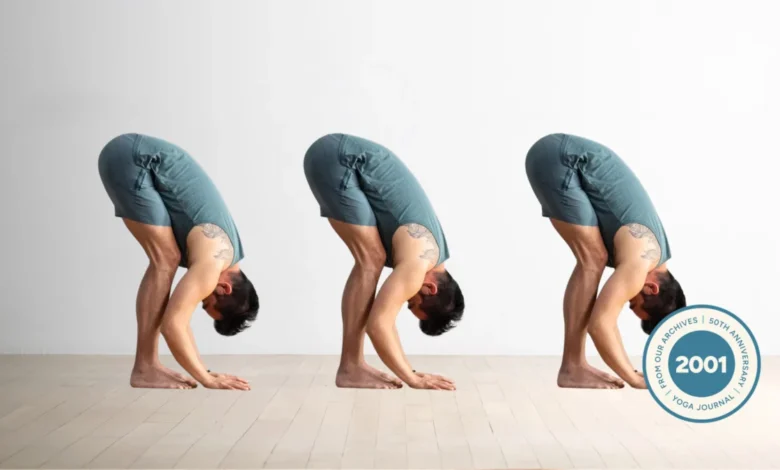
In May 2001, foundational pedagogical insights regarding Uttanasana, commonly known as the Standing Forward Bend, were published to help practitioners navigate these exact somatic barriers. Historical analysis of the pose reveals that the Sanskrit prefix ut translates not only to "intense" but also denotes a point of deliberate, focused action. By examining how this posture was taught at the turn of the 21st century compared to contemporary biomechanical understandings, modern physical culture experts can trace a direct line between ancient postural discipline and contemporary stress-mitigation science.
Anatomical Realities and the Language of Pain
When a practitioner—particularly a beginner—first attempts Uttanasana, the posture immediately directs focal attention to areas of the body that are tight, unresponsive, or unaccustomed to load. Stiff practitioners must negotiate with acute physical sensations to release deep-seated restrictions in the posterior kinetic chain, specifically the calves, hamstrings, and gluteal attachments.
For novices, the simultaneous demand to lengthen the spine while folding deeply creates a complex puzzle of opposing muscular forces. Attempting conscious relaxation while receiving persistent sensory inputs of discomfort can trigger a false neurological alarm, tricking the brain into believing that the muscular resistance is a protective shield against injury.
Biomechanically, however, this deliberate confrontation forces the mind out of autopilot and into an active, highly alert state. By filling the gaps in a beginner’s scattered attention, the posture presents a microcosm of a high-stress situation. Practitioners are given a controlled environment to observe their internal resistance, monitor their breath, and systematically overcome the mental aversion to discomfort.
Chronological Framework for Safe Execution
Executing Uttanasana safely requires a structured, progressive sequence, particularly for individuals with sedentary lifestyles or pre-existing lower back vulnerabilities. Integrating the pose into a daily or weekly movement routine benefits from a strict chronological warming process to prevent acute strain on the lumbar spine and posterior chain.
Phase One: Morning Activation and Spinal Preparation
Particularly for morning practitioners whose bodies are naturally stiffer due to overnight fluid accumulation in the intervertebral discs, initiating movement with direct heat can improve tissue elasticity. A brief application of warm water focused on the back in a shower helps prime the spinal column. Following this, practitioners should begin on the floor in a comfortable cross-legged seated position, gently hinging forward from the hips to send a neurological signal of impending movement to the pelvic girdle and lower back.
Phase Two: Lengthening Through Downward-Facing Dog
From the seated position, transition smoothly into Adho Mukha Svanasana (Downward-Facing Dog). This intermediate posture begins the critical work of decompressing the spine, lengthening the calves, and opening the hamstrings without subjecting the lower back to the heavy leverage of a full forward fold.
Phase Three: Transitioning to the Forward Bend
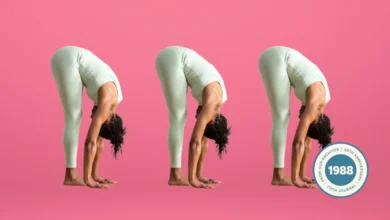
From Downward-Facing Dog, on an exhalation, step or jump both feet forward toward the hands. As you inhale next, slowly straighten the legs while keeping the fingertips or hands in contact with the floor. Lift and lengthen the spine while maintaining a forward gaze. The inhalation should actively expand the back of the ribs and lungs, using this internal volume to support the thoracic spine’s upward lift. Simultaneously, apply a downward grounding pressure onto the iliac crests—the top of the hip bones.
Phase Four: Final Postural Integration
On the subsequent exhalation, completely release the weight of the head and shoulders. Slowly shift the body’s center of gravity forward until the balls of the feet bear the primary load, taking care not to let the heels lift or the toes grip the floor defensively. To anchor the heels, apply a sustained downward energy from the tops of the knees straight down into the floor.
Modifications and Safety Protocols for Diverse Practitioners
Recognizing that practitioners possess varying degrees of physiological flexibility, anatomical safety guidelines must be strictly observed to prevent lumbar injury.
For individuals with limited hamstring mobility whose hands do not effortlessly reach the floor, modifications are essential. Palms should rest flat against the front of the shinbones, maintaining straight legs without forcing the spine to round excessively. Conversely, if a practitioner suffers from a vulnerable lower back, the feet should be positioned at a standard hip-width distance, with the heels turned slightly outward relative to the big toes.
Throughout the hold—which should last between five and ten conscious cycles of breath—the arms should never be used to forcefully pull the spine deeper into the fold. Instead, the subtle expansion of the inhalation should lift the torso, while the exhalation allows gravity to yield the spine downward. Practitioners must continuously monitor weight distribution, ensuring it does not sink passively back into the heels.
Exiting the Posture and Preventing Lumbar Strain
The transition out of Uttanasana is frequently where minor injuries occur due to abrupt movements or unmanaged muscular gripping. To exit the posture safely:
- Inhale slowly while drawing the navel slightly inward toward the spine.
- Ensure the buttocks and the diaphragm remain passive and soft; gripping these areas instantly compromises the lumbar spine.
- Keep the legs straight and allow the head to remain heavy, coming up last so that the upper body unfolds vertebra by vertebra.
- Return to a fully upright standing position with the arms resting naturally at the sides.
Broader Physiological and Psychological Implications
When mastered through patient, consistent application, Uttanasana serves as a gateway to more advanced seated forward folds and foundational inversions. Beyond its biomechanical utility in lengthening the posterior chain, traditional hatha yoga philosophy and modern somatic research converge on the pose’s systemic health benefits.
Medical and wellness practitioners note that deep forward folds stimulate the parasympathetic nervous system, helping to counteract the hyper-aroused "fight-or-flight" state induced by daily psychological stressors. By compressing the abdominal cavity gently during the fold and releasing it upon the ascent, the practice aids in stoking the digestive fire (agni) while simultaneously rejuvenating the central nervous system.
Ultimately, the physiological confrontation experienced within Uttanasana translates into broader psychological resilience. By learning to remain calm, breathe rhythmically, and maintain focus amidst intense physical feedback, practitioners develop an internalized intelligence. This cultivated awareness equips individuals to approach external confrontations in their professional and personal lives not as threats to be avoided, but as manageable components of sustained human growth.