Modern grocery shopping has undergone a profound transformation over the last several decades, shifting from a model centered on whole, farm-sourced ingredients to a system dominated by highly engineered, ultra-processed products. As food technology has advanced, the industry has prioritized shelf stability, uniform flavor profiles, and cost-efficiency, often at the expense of nutritional integrity. This evolution has led to the proliferation of what nutrition experts often term "fake foods"—products that mimic the appearance, texture, and taste of traditional staples while being constructed from a complex array of additives, thickeners, and fillers.
The Evolution of the Manufactured Diet
The shift toward manufactured food accelerated in the mid-20th century, driven by the "low-fat" movement of the 1970s and 1980s. As health authorities encouraged the reduction of dietary fats, food scientists faced a significant challenge: fat provides essential texture and flavor. To maintain the appeal of food products without the traditional fat content, manufacturers turned to food engineering. This resulted in the widespread use of gums, starches, and artificial sweeteners to rebuild the sensory experience of food.
Current data from the National Institutes of Health (NIH) indicates that ultra-processed foods now account for nearly 60% of the average American caloric intake. While not every unfamiliar ingredient is inherently toxic, the cumulative impact of a diet high in these substances has been linked in numerous observational studies to increased risks of obesity, cardiovascular disease, and metabolic disorders.
Top 10 Reconstructed Foods in the Modern Pantry
1. Coffee Creamers
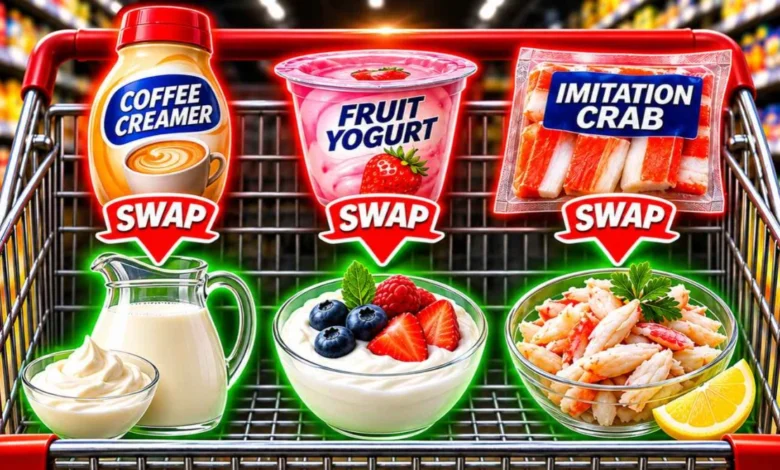
Traditional cream or half-and-half consists of one or two ingredients: milk and cream. In contrast, many commercial non-dairy creamers are sophisticated chemical emulsions. A typical label often includes a base of water and vegetable oils—such as soybean or canola—thickened with emulsifiers like dipotassium phosphate and stabilized with carrageenan or cellulose gel. These products frequently utilize high-fructose corn syrup and artificial flavorings to replicate the richness of dairy, resulting in a product that bears little biological resemblance to its original name.
2. Industrial Bread
While artisanal bread relies on the long-form fermentation of flour, water, salt, and yeast, industrial bread production is optimized for speed. To ensure mass-market loaves remain soft for weeks on store shelves, manufacturers add dough conditioners such as azodicarbonamide or DATEM (diacetyl tartaric acid esters of mono- and diglycerides), alongside preservatives like calcium propionate. This rapid processing lacks the enzymatic breakdown that occurs during natural sourdough fermentation, which many believe contributes to modern digestive sensitivities.
3. Fruit Yogurt
The "fat-phobia" of the late 20th century stripped yogurt of its natural creaminess. To compensate, producers use skim milk combined with a cocktail of thickening agents, including modified corn starch, pectin, and gelatin. To mask the lack of fat and the tartness of the fermentation process, high levels of added sugar or artificial sweeteners are incorporated. A standard serving of flavored, low-fat yogurt can contain as much added sugar as a dessert, effectively neutralizing the health benefits associated with the probiotic cultures.
4. Margarine and Spreadable Fats
Margarine was originally developed as a cheap, shelf-stable alternative to butter. Historically, it relied on partially hydrogenated oils, which are a primary source of trans fats. While the FDA has largely phased out the use of partially hydrogenated oils, modern spreads still rely on industrial seed oils that are heavily processed and deodorized. These oils are susceptible to oxidation, and the manufacturing process often strips away the natural phytonutrients found in whole-food fats.
5. Processed Cheese Products
Products labeled as "processed cheese food" or "cheese product" are distinct from natural cheese. By utilizing emulsifying salts like sodium citrate and sodium phosphate, manufacturers can melt cheese scraps and combine them with milk protein concentrates, whey, and vegetable oils. This creates a product that melts perfectly and never separates, but it sacrifices the nutrient density and complex microbial profile of aged, traditional cheese.

6. Fruit Drinks vs. Real Fruit
The distinction between juice and "fruit drink" is a significant area of consumer confusion. While 100% fruit juice is a concentrated source of sugar, "fruit drinks" may contain as little as 1% to 10% actual juice. The remainder is typically water, corn syrup, artificial colors (such as Red 40 or Yellow 5), and synthetic flavorings. Because these drinks lack the fiber found in whole fruit, the glycemic response is rapid, leading to sharp spikes in blood glucose levels.
7. Reconstructed Chicken Nuggets
The transition from whole-muscle protein to "formed" meat represents a major change in food quality. Many chicken nuggets are produced by grinding chicken trimmings, skin, and sometimes mechanically separated meat into a paste, which is then bound with starches and soy proteins. This process allows manufacturers to dilute expensive protein with cheaper fillers. The resulting product is often pre-fried in industrial oils, which can lead to high levels of inflammatory omega-6 fatty acids.
8. Pre-Grated Parmesan
The convenience of pre-grated cheese comes with a cost. To prevent clumping in the bag, manufacturers coat the cheese in anti-caking agents, most commonly powdered cellulose—a wood-pulp derivative—or potato starch. While these additives are generally recognized as safe, they represent a dilution of the product. Furthermore, some lower-cost "Parmesan" products contain little to no actual Parmesan cheese, relying instead on mixtures of younger, cheaper cheeses and fillers.
9. Imitation Crab (Surimi)
Surimi, the Japanese term for "ground meat," is the standard for imitation crab. It is produced by taking white fish like pollock, washing it to remove fat and color, and grinding it into a paste. To create the final product, starch, egg whites, sorbitol, and crab extract are added. The result is a highly processed seafood analog that contains significantly higher levels of carbohydrates and lower levels of the vitamins and minerals found in fresh, wild-caught crab.
10. Honey and Adulteration
Honey remains one of the few natural sweeteners that retains some enzymes and antioxidants. However, the global honey market has faced intense scrutiny for "honey laundering," where honey is diluted with rice, beet, or corn syrups. While the FDA has increased monitoring, consumers are advised to look for raw, unfiltered, or locally sourced honey to ensure purity.
Broader Implications and Regulatory Oversight
The prevalence of these products has sparked a debate regarding labeling transparency. Regulatory bodies, such as the FDA, require ingredients to be listed in descending order by weight, yet the complexity of modern ingredient lists—often including items like "natural flavors," which can contain dozens of hidden chemicals—makes it difficult for the average consumer to make informed choices.
From a public health perspective, the implication is clear: the more "reconstructed" a food is, the further it likely drifts from its nutritional origin. Nutritionists emphasize that the "Simple Swap" philosophy—choosing items with fewer, recognizable ingredients—is the most effective way to navigate the grocery store.
Moving Forward: The Consumer Checklist
To minimize the intake of ultra-processed items, experts recommend adopting a standard label-reading practice:
- The Short List Rule: If a product has more than five ingredients, evaluate whether it is truly necessary.
- Ingredient Recognition: If you cannot pronounce or identify an ingredient as a recognizable food item, exercise caution.
- Primary Ingredient: Ensure the first ingredient is a whole food (e.g., "milk" instead of "water and oil").
- Sugar Content: Be wary of products where sugar, in any of its many forms (syrup, dextrose, maltodextrin), appears in the first three ingredients.
While the modern food landscape is designed for convenience, the responsibility of nutritional oversight has increasingly shifted to the consumer. By prioritizing whole foods and being skeptical of "manufactured" versions of kitchen staples, individuals can regain control over their dietary intake, potentially reducing the long-term health risks associated with the modern, hyper-processed food environment.