ACSM Updates Resistance Training Guidelines to Validate Bodyweight Exercises for Muscle Hypertrophy and Strength


For the first time in nearly two decades, the American College of Sports Medicine (ACSM) has fundamentally revised its clinical guidelines regarding resistance training, marking a watershed moment for the fitness industry. The updated recommendations, which follow a rigorous 17-year hiatus from major revisions, officially validate bodyweight exercises as a scientifically sound, effective, and primary method for increasing muscle mass, strength, and power. This long-awaited update signals a shift in the standard approach to exercise prescription, moving away from the assumption that heavy external loads—such as iron barbells or cable machines—are the sole requirements for significant physiological adaptation.
The new guidance is rooted in an expansive meta-analysis comprising 137 systematic reviews and data sets encompassing more than 30,000 participants. By synthesizing this massive volume of research, the ACSM has concluded that the modality of resistance matters significantly less than the consistency and mechanical principles applied to the movement. Whether an individual utilizes free weights, resistance bands, or simply the force of gravity against their own body mass, the biological outcomes are comparable provided that the training is executed with proper form and follows the physiological requirements for progressive overload.
A Chronology of Clinical Guidelines
The ACSM’s previous stance on resistance training, established in the mid-2000s, leaned heavily toward traditional gym equipment, reflecting the limited body of longitudinal research on calisthenics available at the time. Over the intervening 17 years, the landscape of physical activity has evolved significantly. The rise of the digital fitness era, the global pandemic’s impact on gym access, and a surge in high-quality research regarding home-based exercise have collectively pressured health organizations to re-evaluate their positions.
In 2024, the committee tasked with reviewing the evidence noted that the disconnect between "gym-based" guidelines and the reality of public health needs had become a barrier to entry for many populations. By 2025, the research consensus had solidified: the human body’s musculature does not distinguish between a 50-pound dumbbell and a strategically modified bodyweight movement that achieves the same level of tension. The official 2026 update, therefore, serves as a democratization of fitness, removing the financial and logistical barriers associated with traditional weight training.
The Science of Progressive Overload
Central to the updated ACSM guidelines is the reaffirmation of "progressive overload"—the principle that muscles must be subjected to increasing levels of stress to continue adapting. Fitness experts have long debated how to achieve this without adding physical weight plates. The new guidance provides a roadmap for implementation: as an individual’s strength increases, the exercise difficulty must evolve.
This is achieved through several variables beyond just adding weight. Increasing the number of repetitions, reducing the recovery intervals between sets, slowing down the tempo (time under tension), or transitioning to more biomechanically disadvantageous positions (such as elevating the feet in a push-up to shift the center of gravity) are all recognized as valid methods for stimulating hypertrophy. The literature suggests that the traditional "hypertrophy range" of 8 to 12 repetitions remains a golden standard for muscle growth, though the guidelines acknowledge that as athletes become more advanced, higher-volume sets become necessary to maintain the stimulus.
Fundamental Movements for Total Body Conditioning
To provide actionable, equipment-free options for the public, the updated guidelines highlight five fundamental movement patterns that target all major muscle groups. These movements are designed to be scalable, ensuring they are accessible to sedentary adults while remaining challenging enough for seasoned athletes.
Upper Body: The Push-Pull Dynamic
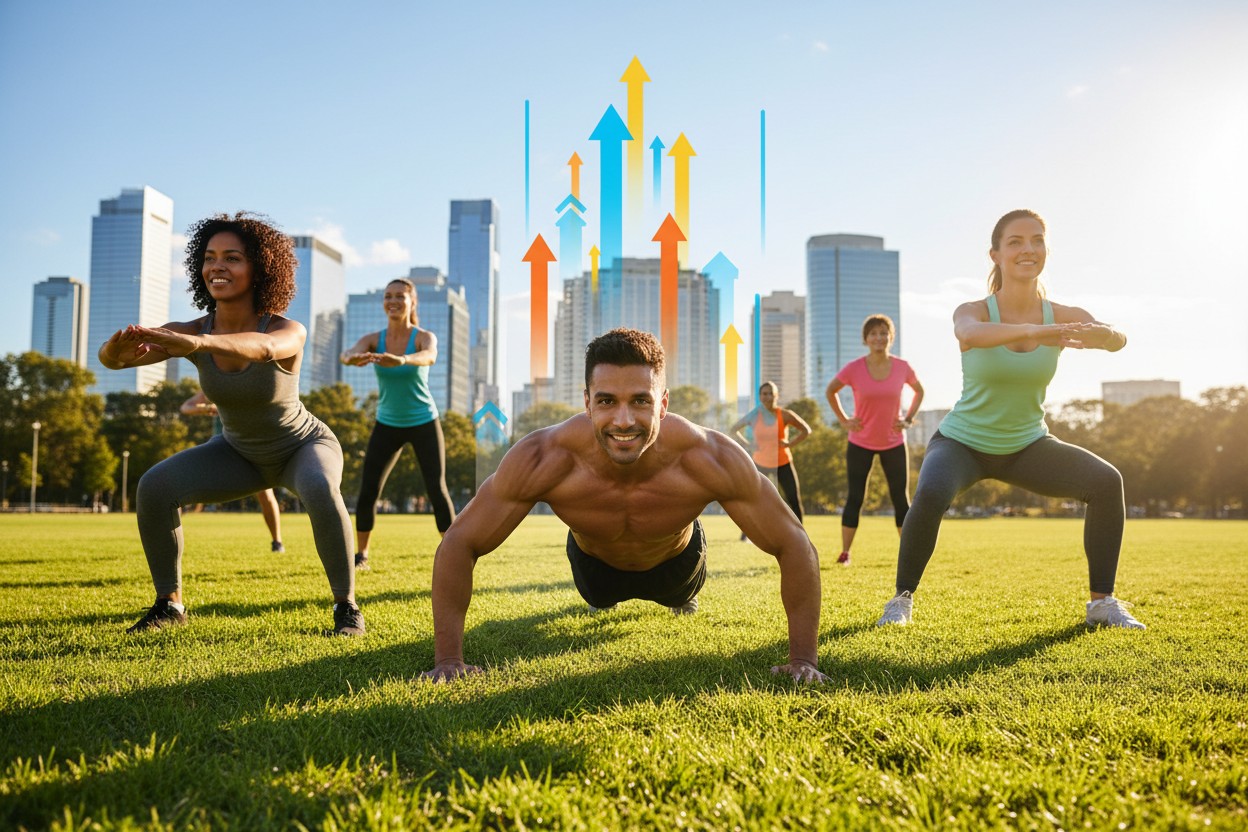
The push-up remains the gold standard for upper body development, targeting the pectoralis major, anterior deltoids, and triceps, while simultaneously engaging the core musculature for stability. The guidelines emphasize that proper form—maintaining a neutral spine and full range of motion—is the primary driver of efficacy.
Conversely, the pull-up addresses the posterior chain of the upper body, specifically the latissimus dorsi, rhomboids, and biceps. Because pull-ups are often a high barrier to entry, the ACSM now officially endorses regression strategies. Utilizing resistance bands for assistance or performing "negative" pull-ups—where the individual slowly lowers themselves from the top position—allows beginners to build the necessary strength to perform the full movement eventually.
Lower Body: Squats and Lunges
The squat is categorized as a "cornerstone" exercise for functional longevity. By engaging the quadriceps, gluteus maximus, and hamstrings, the squat provides a comprehensive lower-body stimulus. Furthermore, the guidelines highlight that the squat’s secondary benefit is improved balance and proprioception, which are critical factors in fall prevention among aging populations.
Lunges serve as the necessary unilateral component of the training regimen. By isolating one leg at a time, lunges force the stabilizer muscles in the hips and core to work harder, addressing common muscle imbalances that occur in daily life. The guidelines suggest that once a standard lunge becomes comfortable, moving toward split squats or reverse lunges can provide the necessary intensity for continued growth.
Posterior Chain: The Glute Bridge
Often overlooked in traditional gym settings, the glute bridge has been elevated to a foundational movement in the new guidelines. By lying supine and driving the hips upward, the exerciser directly targets the glutes and hamstrings. This movement is particularly valuable for individuals who spend long hours sitting, as it encourages the activation of dormant posterior chain muscles. For those requiring more intensity, the single-leg glute bridge provides a significant spike in difficulty without the need for external weight.
The Role of Consistency Over Intensity
A significant takeaway from the 2026 report is the de-emphasis of "intensity" in favor of "consistency." For years, the fitness industry promoted high-intensity interval training and extreme lifting protocols that often led to burnout or injury. The ACSM’s updated stance suggests that a moderate, consistent routine performed at least twice per week for each major muscle group is significantly more effective than sporadic, high-intensity workouts.
This shift reflects a broader public health focus on adherence. By stripping away the need for gym memberships, expensive equipment, or high-intensity threshold training, the ACSM aims to increase the total number of individuals engaging in regular, safe resistance training. The data indicates that adherence is the single greatest predictor of long-term muscle health and metabolic function.
Safety, Pain Management, and Clinical Responsibility
The guidelines are not without strict caveats. While muscle fatigue—the feeling of temporary weakness following a set—is a necessary component of the training process, the report draws a sharp line between fatigue and pain. Sharp, localized joint pain, dizziness, or persistent discomfort are identified as red flags that should prompt an immediate cessation of the activity.
The ACSM stresses the concept of "internal monitoring," noting that individuals bear the responsibility for their own physical limits. In the event of persistent symptoms, the guidelines recommend seeking professional medical evaluation. Furthermore, the committee warns against the common mistake of "forcing" a movement when the body is not yet prepared. Instead of pushing through pain, the guidelines advocate for "regressing"—choosing an easier variation of the exercise that allows for perfect form and a full, pain-free range of motion.
Implications for Public Health
The broader impact of these updated guidelines is expected to be significant. By legitimizing bodyweight training as a primary health intervention, the ACSM has provided doctors and physical therapists with a simplified, cost-effective tool to combat age-related muscle loss (sarcopenia) and metabolic decline.
Public health advocates suggest that this validation could lead to a cultural shift where fitness is no longer perceived as a luxury that requires a commercial gym. Instead, it becomes a daily, portable practice. The implications for the aging population are particularly profound, as the emphasis on functional movements like squats and glute bridges directly correlates with the ability to live independently for longer durations.
In summary, the 2026 ACSM guidelines represent a maturation of exercise science. By stripping away the requirement for external hardware, the organization has aligned its recommendations with the reality of human anatomy and the practical constraints of modern life. The message is clear: the most effective equipment for strength training is the human body itself, provided it is used with consistency, proper form, and a commitment to gradual, incremental progress.