This article delves into the burgeoning landscape of health optimization, dissecting the myths from the realities. It aims to provide a clear, fact-based understanding of what genuinely contributes to long-term health and well-being, helping individuals make informed decisions about their bodies and lives amidst a cacophony of conflicting advice.
The Lure of Longevity: A Modern Phenomenon
The concept of "optimizing" one’s health for extreme longevity has transcended niche circles to become a mainstream cultural phenomenon. Health and longevity advice now saturates podcasts, books, social media platforms, and even casual conversations. This movement has been amplified by influential "figureheads" – popular podcasters, health experts like Dr. Peter Attia and Dr. Andrew Huberman, and biohackers such as Bryan Johnson, who publicly detail their meticulous and often costly regimens.
The appeal is understandable. The prospect of a longer, healthier life, coupled with the comforting sense of control derived from meticulously designing a "perfect" health plan, is highly attractive. However, for organizations like Precision Nutrition (PN), which has coached hundreds of thousands of individuals through the complexities of real human lives, the notion of "optimal" is rarely realistic, nor is it strictly necessary.

PN’s extensive experience suggests a counterintuitive truth: modest, consistent efforts toward fundamental health and well-being often yield superior and more sustainable results than intense, highly "optimized" protocols. This assertion challenges much of the contemporary narrative, prompting a closer examination of the prevailing myths surrounding health optimization.
Deconstructing the "Optimization" Mythos
The journey toward improved health is frequently presented as an arduous ascent requiring cutting-edge tools and esoteric knowledge. This perspective, however, overlooks the profound efficacy of well-established, foundational practices.
Myth 1: The Basics Are Insufficient for True Longevity
A common misconception dictates that achieving significant health improvements and outliving average life expectancies necessitates a battery of complex, "cutting-edge" strategies. The reality, however, is that the "basics" — regular exercise, a nutrient-rich diet, adequate sleep, stress management, and social connection — are remarkably effective. The primary challenge isn’t their inadequacy, but rather the widespread inconsistency in their application.
Data from the Centers for Disease Control and Prevention (CDC) and other public health bodies consistently reveal that a substantial portion of the population falls short on these fundamental behaviors. For instance, only about 1 in 10 Americans consume the recommended amount of fruits and vegetables daily, and less than a quarter meet the guidelines for both aerobic and resistance exercise. The true impediment to widespread health and longevity is not the absence of exotic interventions like ice baths or vitamin C infusions, but the consistent failure to implement relatively simple, proven habits. Individuals who consistently adhere to a well-rounded set of health-promoting behaviors, even with 80-90 percent consistency, are likely already operating near their peak optimization potential.

Myth 2: More Effort Always Equals More Benefit
The logical extension of "basics work" might seem to be "doing them perfectly and as much as possible will yield even greater health." This, however, ignores the principle of diminishing returns. Beyond a certain threshold, additional effort in health and fitness begins to yield progressively smaller benefits, eventually plateauing or even introducing counterproductive effects.
Pushing for excessive perfection or introducing undue complexity into a health regimen can lead to several adverse outcomes: increased stress and anxiety about adherence, burnout, potential injury from overtraining, and the erosion of enjoyment from daily life. What is the value of an extended lifespan if the pursuit itself detracts from a full, well-rounded, and enjoyable existence? While effort is crucial, an excessive amount past a certain point is not necessarily better.
Myth 3: Cutting-Edge Strategies Offer Significant, Proven Benefits
The appeal of novel supplements, therapies, and "biohacks" promoted by influencers is undeniable. They promise shortcuts or breakthroughs that traditional approaches seemingly lack. However, a critical look at the scientific evidence supporting many of these advanced, complex strategies reveals a significant gap. Much of the research touted in the longevity optimization sphere is either conducted on animal models (primarily mice), observational in nature, purely theoretical, or based on very small human trials of short duration.
The scientific consensus often lags behind popular trends. Many fringe methods and supplements, while heavily marketed, lack robust, long-term human studies to confirm their efficacy and, more importantly, their safety. Regulatory bodies like the FDA often have limited oversight over the supplement industry, meaning consumers bear the burden of vetting claims. Prioritizing foundational health behaviors with established, long-standing scientific validation is a far more prudent investment of effort and resources than chasing unproven, potentially unsafe interventions.

Myth 4: It’s an All-or-Nothing Endeavor
The sheer volume and intensity of "optimal" health advice can be overwhelming, leading some to adopt an "all-or-nothing" mindset. The thought process might be: "If I can’t commit to waking at 5 a.m. for a 90-minute high-intensity workout, then why bother at all?" This paralysis by analysis can lead to complete inaction.
However, internal data from coaching programs, such as Precision Nutrition’s year-long initiative, demonstrates that even clients who practiced basic health habits with less than 50 percent consistency still achieved measurable, significant results. For example, individuals with 10-49% consistency still reported an average loss of 11 pounds and several inches from their waists and girths. This evidence powerfully refutes the "all-or-nothing" fallacy, highlighting that consistent, albeit imperfect, progress is both achievable and impactful. Great health is not an exclusive domain reserved for the hyper-optimized; it is accessible through sustainable, incremental improvements.
The Foundational Pillars of Enduring Health
Rather than succumbing to the pressures of "optimization culture," individuals are encouraged to embrace a sustainable, impactful approach to health. This involves focusing on core health behaviors that have a strong evidence base for promoting healthspan and lifespan.
1. Physical Activity: The Movement Imperative
Unanimously endorsed by health experts, regular physical activity is paramount. Beyond maintaining a lean physique and enhancing mood, energy, and functional capacity, exercise is a potent longevity intervention. A landmark study of Harvard alumni revealed that any level of physical activity significantly reduced the risk of all-cause mortality, irrespective of body weight, blood pressure, smoking status, or genetic predisposition.

Further research involving over 270,000 older adults demonstrated that even low amounts of physical activity drastically decreased the risk of death from cancer, cardiovascular disease, and all other causes. The steepest decline in risk was observed with 7.5 to 15 MET-hours of activity per week (Metabolic Equivalent Hours, a measure of energy expenditure). While exceeding this range offered additional benefits, the rate of return diminished.
Even simple activities like walking offer profound benefits. A study of 28,000 adults found that every 1,000-step increase in daily steps was associated with a 12 percent lower risk of death, with benefits evident from as few as 2,500 steps and continuing up to 17,000. Specifically for cognitive health, just 3,826 steps daily were linked to a 25 percent reduced risk of dementia, while 9,826 steps daily correlated with a 50 percent reduction.
Combining cardiovascular activity with resistance or weight-bearing exercise is ideal. Resistance training preserves muscle mass, enhances mental sharpness, improves cancer survival odds, supports metabolic health, and significantly reduces the risk of falls—a leading cause of death among older adults—by improving balance, muscle stability, and bone density. Conversely, a sedentary lifestyle doubles the risk of premature death compared to physical activity, increasing susceptibility to cardiovascular disease, diabetes, hypertension, and various cancers.
Optimal Dose and Adherence:
Standard recommendations advise at least 150 minutes of moderate-intensity aerobic activity or 75 minutes of vigorous-intensity aerobic activity per week, coupled with two full-body resistance training sessions. Further benefits accrue up to 300 minutes of moderate or 150 minutes of vigorous aerobic activity, plus three resistance sessions. Unfortunately, only 24 percent of Americans meet both aerobic and resistance exercise recommendations, and fewer than 47 percent meet aerobic guidelines alone.

While more exercise is generally better up to a point, overtraining can be detrimental. Excessive volumes of endurance exercise (e.g., beyond 7-10 hours of cardio and 3-4 resistance sessions per week) may disrupt hormone levels, impair sleep and mood, cause chronic fatigue, and even increase the risk of myocardial fibrosis and atrial fibrillation, illustrating the "Extreme Exercise Hypothesis" where both very low and extremely high exercise levels carry elevated health risks.
2. Nutritional Wisdom: Fueling Longevity
A nourishing diet doesn’t require extreme complexity but rather a focus on a few key fundamentals.
Key 1: Prioritize Whole and Minimally-Processed Foods. These foods are naturally rich in fiber, healthy fats, vitamins, minerals, and phytochemicals, and are less calorie-dense than highly- or ultra-processed foods (UPFs). They contain less added sugar, sodium, and trans fats—compounds directly linked to increased risks of cardiovascular disease, diabetes, obesity, and certain cancers. Diets abundant in whole foods are associated with lower rates of depression, heart disease, type 2 diabetes, and improved longevity.
Conversely, the largest study on processed foods, involving nearly 10 million participants, linked UPFs to 32 harmful health outcomes, including mental health disorders and all-cause mortality. Another study found that consuming four or more servings of UPFs daily increased all-cause mortality risk by 62 percent. The goal is not rigid avoidance but a shift along the continuum of food processing, aiming for overall dietary patterns rich in whole or minimally-processed options.

Optimal Dose and Adherence:
While no formal guidelines exist for minimally-processed foods, experience suggests significant health improvements and satisfaction when 70-80 percent of one’s diet consists of these foods. Even a shift to 50 percent can yield substantial benefits. Currently, Americans derive only about 28.5 percent of their calories from whole or minimally-processed foods, with 56 percent coming from highly- or ultra-processed options. Consuming up to 90 percent minimally-processed foods may maximize benefits, but beyond that, additional gains are likely negligible, and some processed foods (like protein powder or commercial salad dressings) can even support health goals or life enjoyment.
Key 2: Consume Five Servings of Fruits and Vegetables Daily. This oft-repeated advice is backed by robust evidence. A meta-analysis of over 1.8 million people found that consuming more fruits and vegetables was significantly associated with a decreased risk of death, with benefits plateauing at five servings daily. Individuals consuming five servings per day had a 13 percent lower risk of death from any cause compared to those eating two servings. Fruits and vegetables also reduce the risk of hypertension, coronary heart disease, stroke, and possibly cancer and weight gain.
Optimal Dose and Adherence:
A healthy target is five fist-sized servings daily (e.g., three vegetable, two fruit), with a variety of colors to ensure a diverse intake of beneficial phytochemicals. However, Americans average only 2.5 servings of produce daily, with only 12.2 percent meeting fruit recommendations and 9.3 percent meeting vegetable recommendations. The life-extending benefits generally plateau at five servings, though higher intake can still aid weight management due to their fiber and water content.
Key 3: Ensure Adequate Protein Intake. Protein is a critical macronutrient, especially with aging. Plant protein is linked to a reduced risk of cardiovascular disease and all-cause mortality. While animal protein research is mixed, minimally processed fish, poultry, and low-fat dairy are generally good sources. Processed red meats (bacon, hot dogs) should be limited due to links with diabetes, cardiovascular disease, and cancer; even unprocessed red meat should be kept below 18 oz (4-5 palm-sized portions) per week.

Sufficient protein intake (at least 1.2 g/kg body weight) significantly reduces the risk of sarcopenia (muscle loss), frailty, and neuromuscular decline, particularly in older adults. Protein is also vital for muscle maintenance and growth, bone health, immunity, and satiety, aiding fat loss and body recomposition.
Optimal Dose and Adherence:
The USDA’s minimum recommendation is 0.8 g/kg, but newer research suggests 1.2 g/kg (0.55 g/lb, or 3-5 palm-sized portions) is a better minimum, especially for older adults. For muscle growth, retention, or vigorous exercise, 1.6 to 2.2 g/kg (0.75-1 g/lb, or 4-8 palm-sized portions) is optimal. Most adults meet the 0.8 g/kg mark, but up to 10% of young women and 46% of older adults do not. For individuals on GLP-1 medications, a minimum of 1.2 g/kg (ideally closer to 1.6 g/kg) is crucial to mitigate muscle loss. Beyond 1.2 g/kg, benefits plateau for sedentary individuals, but higher intake supports specific goals like muscle building or recovery from intense exercise.
3. The Power of Rest: Prioritizing Sleep
Adequate, quality sleep is as fundamental to health as diet and exercise. Research shows men who get enough sleep live almost five years longer, and women two and a half years longer, than those who don’t. Sleep is crucial for heart health, rivaling the importance of exercise, diet, and blood pressure control. A one-hour decrease from 7 hours of sleep per day is associated with an 11 percent increased risk of cardiovascular disease and a 9 percent increased risk of type 2 diabetes. Older adults sleeping less than 6 hours per night face a higher risk of dementia and cognitive decline, as deep sleep is vital for clearing neurotoxic waste products from the brain.
Optimal Dose and Adherence:
Sleep experts recommend 7 to 9 hours per night for most adults, with at least 7 hours on most nights. The ideal amount is highly individual, defined by feeling refreshed upon waking and maintaining sustained energy throughout the day. Approximately one-third of U.S. adults do not meet the 7-9 hour recommendation. While 7-9 hours is optimal, sleeping significantly more (over 9 hours) has been associated with increased risks of cardiovascular disease, type 2 diabetes, and mortality. However, this correlation is likely due to underlying health issues (e.g., depression, sleep apnea) rather than excess sleep itself being causative.

4. Mind-Body Harmony: Mastering Stress
Chronic, unmanaged stress profoundly impacts nearly every physiological system, leading to brain fog, frequent infections, poor recovery, and weight gain. It increases heart rate, blood pressure, and inflammation, elevating the risk of cardiovascular disease. Long-term stress also exacerbates mental and emotional health issues, increasing susceptibility to anxiety, depression, and substance abuse.
However, stress is not inherently negative; it is a normal, natural, and often beneficial part of life that can foster motivation, purpose, and engagement. The goal is not to eliminate stress but to cultivate healthy coping mechanisms, appropriate recovery strategies, and overall resilience. This can involve simple mindset shifts—practicing self-compassion, adopting a growth mindset, and reframing stress as a normal part of life—all linked to better coping. Developing self-regulation skills, such as recognizing emotions and employing diverse coping strategies, enables individuals to recover effectively from stressful events.
Optimal Dose and Adherence:
Stress management should be proportionate to life’s demands. Imagine stress draining a tank, and recovery practices refilling it. Even brief, purposeful recovery (3-5 minutes of deep breathing, journaling, or stepping outside) can be effective. Public health data indicates widespread unmanaged stress, with over a quarter of people in the U.S. and Canada reporting being too stressed to function most days, and over a third unsure how to manage it.
While a routine is beneficial, there are diminishing returns. The aim is a "sweet spot" where one feels energized and engaged, not bored or overwhelmed. Adding more stress reduction techniques beyond this point might not help and could even add to the mental load.

5. The Human Connection: Social Bonds and Health
Social connection is a vital, often underestimated, health imperative. Strong social and emotional support is consistently linked to improved well-being and a 50 percent increased likelihood of survival over any given period. The Harvard Study of Adult Development, an 87-year longitudinal study, found that robust relationships were the strongest predictor of both life satisfaction and longevity, surpassing factors like social class, wealth, IQ, or genetics.
Conversely, social isolation and loneliness significantly increase the risk of heart disease, stroke, type 2 diabetes, depression, anxiety, suicidality, dementia, and premature death. The impact is profound: social isolation’s effect on mortality is comparable to smoking 15 cigarettes per day, exceeding the risks associated with obesity and physical inactivity.
Optimal Dose and Adherence:
Many people lack sufficient social connection; about 1 in 3 adults report feeling lonely, and 1 in 4 lack social and emotional support. Research suggests having three to five close friends with whom one regularly interacts (1-3 times per week, in-person or via phone) yields the most social benefit. A smaller, deeper network is often more impactful than a large network of acquaintances.
Excessive social engagement (daily or multiple times daily) might paradoxically increase mortality risk due to mental, emotional, and physical fatigue, and potential links to risky behaviors like heavy alcohol consumption. It can also divert time and energy from other essential health and life-building activities. The goal is enriching social interaction that brings value without leading to exhaustion or neglecting other priorities.

6. Harm Reduction: Avoiding Major Detractors
Minimizing exposure to known harms is a critical yet often overlooked aspect of long-term health. The two most significant culprits are smoking and excessive alcohol consumption.
Harm 1: Don’t Smoke. The detrimental effects of smoking are well-established. Despite this, smoking remains relatively common, with over 13% of U.S. adults smoking cigarettes and 1.9% using smokeless tobacco. The World Health Organization (WHO) estimates over 8 million premature deaths annually from tobacco use, making it a leading risk factor for premature death and various chronic conditions, including heart disease, stroke, emphysema, and a quarter of all cancer deaths globally.
Harm 2: Limit Alcohol. The scientific consensus is clear: alcohol has negative health implications, especially with regular heavy use. It plays a causal role in over 200 diseases, including liver disease, heart disease, at least seven types of cancer, depression, anxiety, alcohol use disorders, and dementia. In 2019, 2.6 million deaths worldwide were attributed to alcohol, making it the leading risk factor for death among individuals aged 15-49, accounting for 3.8% of female and 12.2% of male deaths in this demographic.
Optimal Dose and Adherence:
U.S. guidelines recommend moderate alcohol intake: up to one drink per day for women and up to two drinks per day for men. A "drink" contains 14 grams of pure ethanol, equivalent to 12 oz of regular beer, 5 oz of wine, or 1.5 oz of 80-proof distilled spirits. Most Americans exceed these guidelines, with average consumption estimated at over 10 standard drinks per week, likely underestimated due to underreporting. Binge drinking and heavy alcohol use are also prevalent.

In 2023, the WHO stated that no amount of alcohol is "safe," though this remains debated. While alcohol is a known carcinogen, small doses are unlikely to have a significant impact on health. However, risks rise exponentially with heavier drinking, defined as four or more drinks on any single day or eight or more per week for women, and five or more drinks on any single day or 15 or more per week for men. The decision ultimately rests on an individual’s willingness to tolerate risk versus perceived benefits. General recommendations include avoiding alcohol if pregnant or under 21, limiting intake to one drink per day (or none) for most adults, and being honest about consumption levels.
7. Proactive Care: Essential Preventive Health Measures
Amidst discussions of complex longevity protocols, the importance of basic preventive health measures is often overlooked. These "boring" but vital practices include:
- Regular medical check-ups and age-appropriate screenings (e.g., mammograms, colonoscopies).
- Dental care (brushing, flossing, regular cleanings).
- Eye exams and vision correction.
- Vaccinations (flu, tetanus, HPV, shingles).
- Wearing seatbelts and helmets.
- Sun protection.
- Hearing protection.
- Avoiding exposure to environmental toxins.
- Practicing safe sex.
- Managing chronic conditions.
- Adhering to medication as prescribed.
These practices, coupled with common sense and risk avoidance, are immeasurably more impactful than unproven fads. However, access to these measures is not universal. Social determinants of health—such as poverty, racism, and lack of accommodation for disabilities—create systemic barriers for many, making consistent adherence to protective behaviors incredibly challenging. The pragmatic approach is to do the best one can with available resources.
Optimal Dose and Adherence:
Consistency is key: daily brushing and flossing (only 32% of Americans floss daily), always wearing a helmet when cycling (only half of cyclists do), wearing seatbelts (92% usage), and using sunscreen. Regular check-ups and addressing lingering health concerns are also crucial. Hearing loss, a modifiable risk factor for dementia, highlights the importance of protecting hearing (e.g., the 60/60 rule for headphones, earplugs for loud activities). While complete risk elimination is impossible and unnecessary, reasonable efforts in preventive health significantly contribute to overall well-being.

Bonus: Fostering a Sense of Purpose and Meaning
Beyond the physiological and behavioral pillars, a strong sense of purpose and meaning in life consistently correlates with improved health, overall well-being, and longevity. This "purpose" can encompass diverse aspects, such as professional ambition, creative pursuits, raising children, community engagement, or personal growth.
A sense of purpose contributes to longevity by:
- Promoting Healthy Behaviors: Individuals with purpose are more likely to engage in health-promoting activities like adequate sleep and fruit/vegetable consumption.
- Improving Mental Health: A strong sense of purpose is associated with a significantly reduced risk of depression (e.g., 43% lower risk in one study).
- Fostering a Desire to Live: Purpose can instill a deeper desire to live a longer, healthier life to fulfill that purpose, creating a virtuous cycle of motivation and engagement.
This intrinsic motivation for living and striving adds a unique dimension to longevity that differs from mere happiness.
The True Cost of "Optimal": Time, Money, and Quality of Life
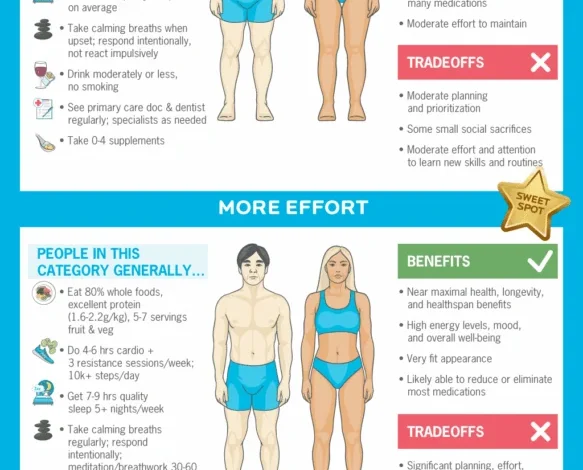
While the foundational behaviors offer substantial benefits, striving for extreme "optimization" comes with significant tradeoffs, primarily in terms of time, money, and potentially, quality of life. Comparing a "healthy" person consistently meeting basic recommendations with an "optimizer" who maxes out all recommendations and pursues fringe interventions reveals a stark difference.

An "optimizer" might invest three to four times the weekly time and financial resources compared to a "healthy" individual. This includes extensive exercise regimens, hyper-specific dietary protocols, advanced biometric tracking, specialized supplements, and costly medical assessments (e.g., full-body MRIs, comprehensive genetic testing, advanced blood panels, hyperbaric oxygen therapy, cryotherapy, stem cell treatments). These additional efforts could easily add $10,000+ per year, often for marginal and unproven benefits.
Furthermore, an overemphasis on health and longevity can negatively impact overall well-being. Extreme regimens often lead to burnout, increasing the risk of abandoning foundational habits. Obsessive focus on physical health can detrimentally affect other domains of "deep health," including relational, existential, mental, and emotional well-being. This can manifest as orthorexia (an unhealthy obsession with healthy eating) or other mental health conditions, where the pursuit of health becomes an anxiety-inducing burden rather than an empowering journey.
The ultimate paradox is that while the goal is a longer, healthier life, the extreme pursuit of it can diminish the joy and richness of life itself. True well-being encompasses not just physical vitality but also life satisfaction, meaningful connections, and a sense of purpose.
Charting Your Own Course: Informed Decisions for Lifelong Well-being
Navigating the complex landscape of health and longevity requires introspection and discernment.

- Clarify Your Goals: Begin by reflecting on your deepest aspirations. What kind of life do you truly desire? How does maximizing healthspan and lifespan integrate with your other life priorities?
- Consider the Tradeoffs: Honestly assess your available resources—time, money, and energy. What level of commitment is realistic and sustainable for you? What are you willing to prioritize, and what are you unwilling to sacrifice for the sake of "optimization"?
- Prioritize the Basics: Systematically review the foundational health behaviors outlined in this article. Identify areas where you are consistently performing well and those where there’s room for improvement. For the vast majority, enhancing consistency in these core areas will yield profound, tangible results, far surpassing the uncertain benefits of trendy, fringe interventions.
- Tune Out the Noise: Recognize that external "experts" on podcasts or social media, while often well-intentioned, are not the ultimate authorities on your life. Empower yourself to make choices that align with your personal values, circumstances, and what truly matters most to you.
Ultimately, the journey to a long and healthy life is a deeply personal one. It is about making informed, intentional decisions that support sustainable well-being and a fulfilling existence, rather than chasing an elusive and potentially detrimental ideal of "perfection." The power lies in consistency, balance, and prioritizing what genuinely enhances your life, not just its duration.
Related posts: