New Resilience Group Curriculum Addresses Sub-Clinical Stress and Burnout, Offering Practical Skill-Building for Sustainable Well-being

A new resilience group curriculum has been introduced to address a pervasive yet often overlooked challenge in mental health: the quiet, chronic struggle experienced by individuals who are functioning outwardly but internally depleted. This innovative program is specifically designed for clients who do not meet the criteria for crisis intervention but are nonetheless grappling with mild-to-moderate stress, anxiety, burnout, or significant life transitions. Developed by Alicia Hawley-Bernardez, Ph.D., LMSW, a trauma-informed therapist and educator, the curriculum aims to equip participants with practical, science-based skills and a reliable structure to foster lasting resilience.
The Rise of Chronic Stress and the Need for Proactive Solutions
In an increasingly demanding world, chronic stress and burnout have become pervasive issues, impacting individuals across all demographics. A 2023 report by the American Psychological Association (APA) indicated that a significant portion of adults continue to report high levels of stress, with many experiencing symptoms that, while not immediately debilitating, are corrosive over time. These include persistent fatigue, difficulty sleeping, irritability, and a general sense of being overwhelmed. Unlike acute crises, which often prompt immediate intervention, this "quiet struggle" can linger for months or even years, slowly eroding well-being and productivity without triggering an urgent call for help. The World Health Organization (WHO) formally recognized burnout as an occupational phenomenon in its International Classification of Diseases (ICD-11), underscoring its widespread impact on professional life and overall health.
This landscape highlights a critical gap in mental health services: the need for proactive, skill-building interventions that can prevent chronic stress from escalating into more severe conditions. Traditional therapy models often focus on processing past trauma or managing acute symptoms. While invaluable, they may not always be the most accessible or appropriate first step for individuals who are primarily seeking tools to navigate ongoing life stressors. The new resilience group curriculum steps into this void, offering a structured, supportive environment where individuals can learn actionable strategies to bolster their psychological fortitude before they reach a breaking point.
A Scientifically-Backed Framework for Resilience
The curriculum is rooted in the principles of positive psychology, focusing on building strengths and adaptive coping mechanisms. It moves beyond theoretical concepts, emphasizing practical application and measurable outcomes. Dr. Hawley-Bernardez, with her extensive background in trauma-informed therapy, identity exploration, and resilience, has crafted a program that prioritizes connection, empowerment, and self-trust. Her expertise ensures that the curriculum is not only evidence-based but also delivered with a deep understanding of the nuanced challenges individuals face.
At its core, the curriculum posits that resilience is not an inherent trait but a trainable skill set. This philosophy empowers participants by reframing their struggles as opportunities for growth and skill acquisition, rather than indicators of personal failing. The program steers clear of trauma processing, instead maintaining a present-focused, skill-building approach that is appropriate for group settings and a broader range of participants. This distinction is crucial, as it allows individuals to engage with their challenges in a safe, contained manner without requiring deep personal disclosures of past trauma.

Defining the Ideal Participant and Practitioner
To ensure the efficacy and safety of the group environment, strict inclusion and exclusion criteria have been established. The curriculum is intended for emotionally stable adults experiencing mild-to-moderate stress, anxiety, burnout, or life transitions. Examples of appropriate participants include the parent struggling with sleep deprivation, the professional pushing through relentless demands, or someone navigating an unexpected life change. These individuals are typically functioning in their daily lives but recognize an unsustainable internal drain and a need for change. They are ready to engage in skill-building and between-session home practice.
Conversely, the curriculum is not suitable for individuals in acute crisis, those actively struggling with severe mental health conditions requiring individual intensive care, or those whose primary need is to process trauma. Facilitators are urged to use their clinical judgment during the screening process to ensure proper participant fit, establishing clear referral pathways for individuals who may require a different level of care.
The program is designed for graduate-level or licensed practitioners, including therapists, counselors, social workers, psychologists, coaches, and educators who run skill-building groups. This requirement underscores the professional standard expected for facilitating sensitive discussions and managing group dynamics effectively. Practitioners are advised to thoroughly read the curriculum, understand its arc, and establish all logistical components—from participant screening to baseline measures—before the first session.
Navigating the Curriculum: A Structured Journey to Fortitude
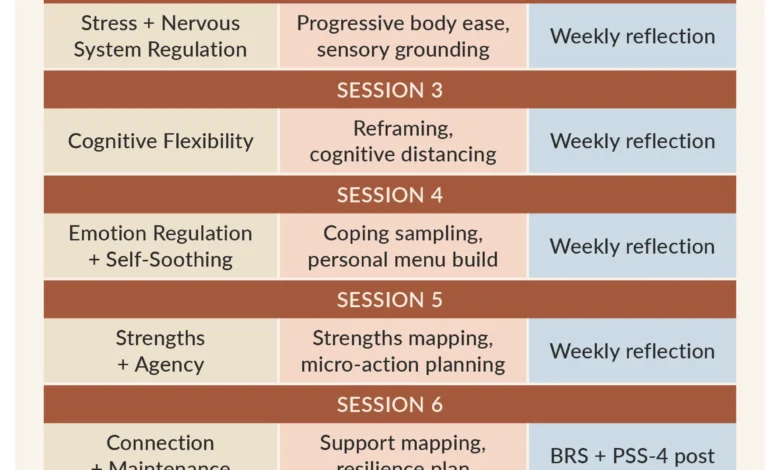
The resilience group curriculum is structured across six core sessions, with two optional sessions available for groups desiring a deeper dive into specific areas. Each session follows a consistent format, incorporating objectives, opening check-ins, core teaching points, in-session exercises, discussions, and homework assignments. This systematic approach ensures a coherent learning progression, building foundational skills before advancing to more complex concepts.
Session 1: Foundational Stabilization
The initial session focuses on orientation, framing resilience as a set of trainable skills, and introducing a stabilization toolkit. Participants are welcomed, group norms and confidentiality are reviewed, and the skill-building focus is reinforced. Baseline measures, such as the Brief Resilience Scale (BRS) and the Perceived Stress Scale (PSS-4), are administered to track progress. Core teaching points include understanding resilience as a dynamic process, identifying personal stress responses, and learning immediate grounding techniques. Exercises involve guided breathwork and body scans, with homework focused on daily regulation practice and journaling about moments of calm.
Session 2: Mastering Nervous System Regulation
Building on stabilization, this session delves into stress physiology and nervous system regulation. Participants learn about the body’s stress response, the sympathetic and parasympathetic nervous systems, and practical techniques to shift out of "fight-or-flight" mode. Core teaching includes the polyvagal theory in simplified terms and the concept of a "window of tolerance." Exercises might involve progressive muscle relaxation, guided imagery, or mindful movement. Homework encourages continued regulation practice and identifying personal triggers and soothing strategies.

Session 3: Cultivating Cognitive Flexibility
This session addresses the mental aspects of resilience, focusing on cognitive flexibility. Participants explore how thoughts influence emotions and behaviors, learning to challenge unhelpful thought patterns and adopt more adaptive perspectives. Core teaching emphasizes cognitive restructuring, recognizing cognitive distortions, and the power of reframing. Exercises could include thought records or gratitude journaling. Homework involves practicing thought challenging and identifying alternative interpretations of stressful events.
Session 4: Enhancing Emotional Regulation and Self-Soothing
Session four is dedicated to understanding and managing emotions. Participants learn to identify, label, and regulate intense emotions without being overwhelmed by them. Core teaching includes emotion identification, distress tolerance skills, and healthy self-soothing techniques. Exercises might involve radical acceptance, sensory grounding, or developing a personal "coping menu." Homework encourages practicing self-soothing techniques and reflecting on coping attempts as information, not failures.
Session 5: Harnessing Strengths and Agency Through Micro-Actions
This session shifts focus to internal resources, exploring personal strengths and agency. Participants identify their unique strengths and learn how to leverage them in challenging situations. The concept of "micro-actions" is introduced, emphasizing that small, consistent steps can lead to significant change. Core teaching includes character strengths assessment and understanding the impact of perceived control. Exercises might involve a strengths spotting activity or planning a micro-action for the week. Homework encourages intentional use of strengths and celebrating small acts of agency.
Session 6: Building Sustainable Connection and Support
The final core session emphasizes the vital role of social connection and external support in resilience. Participants explore their support networks and learn strategies for seeking and offering help. Core teaching points include the benefits of social support, identifying healthy boundaries, and effective communication. Exercises might involve mapping out a personal support network or practicing assertive communication. The session concludes with a post-group measurement using the BRS and PSS-4, a review of learned skills, and a discussion on maintenance strategies.
Optional Sessions: Meaning-Making and Long-Term Maintenance
Two optional sessions are available for deeper engagement. Session 7, "Meaning-Making + Post-Traumatic Growth," explores how individuals can find meaning in difficult experiences and foster post-traumatic growth. It is carefully framed to ensure growth is understood as neither universal nor immediate, and not a measure of healing or worth. Session 8, "Booster, Review, and/or Maintenance," serves as a follow-up, reinforcing learned skills and discussing strategies for long-term resilience maintenance, reminding participants that resilience is an ongoing journey.
Ensuring Effectiveness: Measurement and Home Practice
A cornerstone of this curriculum is its commitment to monitoring progress and demonstrating effectiveness. Beyond the initial and final administration of the Brief Resilience Scale (BRS) and the Perceived Stress Scale (PSS-4)—both free, brief, and well-validated tools—participants engage in brief weekly reflections. These qualitative check-ins complement the quantitative data, offering valuable insights into individual experiences and progress. The data collected helps facilitators identify participants who may need additional support and provides a tangible measure of the group’s impact.

The emphasis on "between-session home practice" is critical. Frame as "skill reps, not perfection," this practice is designed to integrate the learned techniques into daily life. Consistent application outside the group setting is essential for solidifying new habits and transforming theoretical knowledge into lived experience. This iterative process of learning, practicing, and reflecting is fundamental to building enduring resilience.
Expert Facilitation: Guiding Principles and Overcoming Challenges
Effective facilitation is paramount to the success of any group curriculum. The program provides comprehensive guidance on facilitator stance, emphasizing a skill-building, present-focused approach. Facilitators are encouraged to model the practices themselves, maintaining self-regulation, and gently redirecting discussions that veer into trauma narratives back to skill development.
The curriculum also addresses common facilitation challenges, offering practical strategies:
- Oversharing and Co-rumination: Gentle interruption, offering individual follow-up, and reinforcing that participation does not require disclosure.
- Homework Non-completion: Curiosity-based inquiry ("What got in the way?") and encouraging participants to identify the "smallest version" of the task they could realistically accomplish.
- Dominant vs. Quiet Members: Warm interruption of dominant members and explicit, low-pressure invitations to quieter participants, potentially using written reflection before verbal sharing to ensure equitable participation.
- High-Distress Activation: Pausing the exercise, leading a brief group grounding practice without singling out an individual, and offering an explicit opt-out cue at the start of exercises.
- Trauma Disclosures: Interrupting before details are shared, redirecting to skill practice ("What did your nervous system do in that moment?"), and offering individual follow-up after the session.
These guidelines are crucial for maintaining a safe, productive, and therapeutic environment, ensuring that all participants can benefit from the group experience.
Broader Implications: Shaping the Future of Mental Wellness
This resilience group curriculum represents a significant step forward in preventative mental health. By providing accessible, skill-based support for individuals experiencing sub-clinical distress, it can potentially reduce the burden on acute mental health services and foster a more resilient society. The curriculum’s adaptable nature makes it suitable for various settings, including community mental health centers, private practices, and even corporate wellness programs.
For workplaces, where burnout is a growing concern, implementing such a curriculum could lead to improved employee well-being, increased productivity, and reduced turnover. By investing in the resilience of their workforce, organizations can cultivate healthier, more engaged environments. Furthermore, the core skills translate well to adolescent populations, with appropriate language and examples, making it a valuable resource for schools and youth programs, albeit with facilitators experienced in working with minors and adherence to specific ethical guidelines. The flexibility of the curriculum, including its suitability for online delivery, further expands its reach and accessibility.

This initiative aligns with a broader movement in mental health towards proactive self-care and community-based support, acknowledging that well-being is a continuous process that benefits from ongoing skill development and accessible resources.
Conclusion: Resilience as an Ongoing Practice
Ultimately, resilience is not a destination but a dynamic skill set that individuals return to repeatedly, accumulating more tools, self-knowledge, and compassion with each encounter. The skills taught in this curriculum—from nervous system regulation to building support maps and cultivating cognitive flexibility—are designed to be lifelong resources. They are invaluable on challenging days, during overwhelming weeks, and in seasons when life feels particularly demanding. The objective is not to achieve perfection in coping, but to foster familiarity with effective strategies and to know instinctively what to reach for when difficulties arise.
For practitioners looking to offer a comprehensive, ready-to-implement resilience training program, resources like the ResilienceX Masterclass© provide a fully complete workshop, including workbooks, videos, presentations, and white label rights, offering a robust solution for enhancing client well-being. This curriculum offers a beacon of hope and practical guidance for those navigating life’s quieter struggles, empowering them to build a foundation of strength and adaptability that endures.