Understanding Avoidant Attachment: Unmasking Independence as a Protective Mechanism in Adult Relationships

Avoidant attachment style in adults presents a complex psychological profile often masked by traits that society typically values, such as strong independence, remarkable composure, and high capability. These seemingly admirable qualities, however, can belie a deeply ingrained protective strategy rooted in a learned expectation that emotional closeness is inherently uncomfortable, unnecessary, or even unsafe. Rather than openly expressing fundamental attachment needs, an individual’s psychological system adapts by systematically rejecting or downregulating them, a mechanism known as deactivation. This article delves into the nuances of avoidant attachment, exploring its origins, manifestations, and the therapeutic pathways toward fostering greater relational flexibility and earned security, framing it as a protective response rather than a pathological flaw.
The Foundational Framework: Attachment Theory’s Enduring Relevance
To truly grasp the dynamics of avoidant attachment, it is essential to contextualize it within the broader framework of attachment theory, pioneered by British psychoanalyst John Bowlby in the mid-20th century. Bowlby posited that humans possess an innate psychobiological system, the "attachment system," which motivates them to seek proximity to significant others (attachment figures) when distressed, threatened, or in need of comfort and security. This system is crucial for survival and well-being, particularly in infancy and childhood. Mary Ainsworth, a developmental psychologist, further advanced Bowlby’s work through her groundbreaking "Strange Situation" experiments, which identified distinct patterns of attachment based on how infants responded to separations and reunions with their caregivers. These early relational experiences lay the groundwork for "internal working models" – cognitive and emotional schemata that guide an individual’s expectations and behaviors in future relationships.
Secure attachment, characterized by a flexible balance between dependence and autonomy, allows individuals to comfortably seek support and offer it, knowing their needs will generally be met. In contrast, insecure attachment styles – anxious, disorganized, and avoidant – develop when early caregiving environments are less than optimal, leading to adaptive strategies that, while protective in childhood, can create significant challenges in adult relationships.
Defining Avoidant Attachment: Clinical Perspectives and Core Mechanisms

Clinically, avoidant attachment is recognized as an organized attachment pattern marked by a pronounced avoidance of closeness and a low expression of attachment anxiety. This pattern is sustained by a suite of regulatory strategies collectively termed "deactivation" (Freeman, 2025). Rather than being genuinely unemotional or indifferent, individuals with avoidant attachment actively downregulate their attachment needs when those needs are triggered or activated. This process is not a conscious choice in the moment but an automatic, deeply ingrained response.
At the heart of an avoidantly attached individual’s internal working model is a fundamental belief system: "My needs are unlikely to be met safely. I can only rely on myself, and therefore, I must minimize dependence." This logic dictates their approach to intimacy, vulnerability, and interdependence. When faced with emotional intensity or perceived demands for closeness, their system instinctively moves to dampen these needs, maintaining a sense of self-sufficiency and control.
Distinguishing Avoidant Attachment from Other Presentations
A common misconception is to conflate avoidant attachment with other personality traits or psychological conditions. However, understanding its unique underlying mechanisms is crucial for accurate assessment and effective intervention. Avoidant attachment differs significantly from:
- Anxious Attachment: Where needs are amplified and expressed through reassurance-seeking due to a fear of abandonment, avoidant attachment involves the suppression of needs.
- Disorganized Attachment: Often linked to trauma, this style involves a profound internal conflict between desiring closeness and fearing it, leading to unpredictable and contradictory behaviors. Avoidant attachment, conversely, exhibits consistent deactivation.
- Secure Attachment: This style is characterized by a healthy flexibility, allowing individuals to navigate both dependence and autonomy without needing to suppress or intensify their needs (Simmons et al., 2009).
Furthermore, avoidant attachment is distinct from:
- Introversion: A preference for low stimulation, whereas avoidant attachment is a regulation of closeness under emotional activation (Carver, 1997).
- Narcissism: Avoidant attachment is a protective deactivation, not driven by entitlement or grandiosity (Marchlewska et al., 2022; Set, 2021).
- Trauma Shutdown: While superficially similar, trauma-related freeze or dissociation is a direct, threat-based physiological response, distinct from the learned relational distancing of avoidant attachment (Morison & Benight, 2022; Freeman, 2025).
- Autism Spectrum Disorder: Neurodevelopmental differences in social communication are distinct from attachment-based regulation patterns (Martin et al., 2020).
- Depression: Withdrawal in depression is typically linked to low mood or anhedonia, not primarily to the regulation of closeness itself (Zheng et al., 2020).
These distinctions are vital for mental health professionals to ensure that interventions target the correct underlying process, moving beyond surface behaviors to address core regulatory systems.

The Developmental Trajectory: How Avoidance Takes Root
Avoidant attachment typically develops in early caregiving environments where a child’s attempts to seek comfort or connection are consistently met with unresponsiveness, rejection, or even intrusive overstimulation (Zayas et al., 2011). Key conditions include:
- Emotional Unavailability: Caregivers may be physically present but emotionally distant, uncomfortable with their child’s expressions of vulnerability or distress.
- Discouragement of Emotional Expression: Children may learn that expressing needs or emotions leads to punishment, criticism, or withdrawal from the caregiver.
- Excessive Pressure for Independence: Caregivers might implicitly or explicitly push children towards self-sufficiency prematurely, signaling that dependence is a weakness or burden.
- Intrusive or Controlling Parenting: In some cases, caregivers might be overly involved in a way that feels overwhelming or suffocating, leading the child to seek distance as a means of maintaining autonomy.
Under these conditions, children learn that:
- Their attachment needs are not consistently met or are even met with negative reactions.
- They can only rely on themselves for comfort and regulation.
- Emotional displays are ineffective or dangerous, leading to their suppression.
- Closeness often comes at the cost of their autonomy or well-being.
These early patterns solidify into the internal working models that continue to shape adult relationships, influencing how individuals perceive intimacy, manage conflict, and navigate interdependence (Chopik et al., 2014).
The Deactivation Cycle: A Core Mechanism of Avoidance
At the very heart of avoidant attachment lies deactivation – a complex set of regulatory strategies designed to reduce the activation of the attachment system when closeness, dependence, or emotional intensity is perceived as threatening (Uccula et al., 2022). This manifests not as an inability to feel, but as a systematic dampening of needs. Common deactivation strategies observed in individuals with avoidant attachment include (Richardson et al., 2022):

- Cognitive Distancing: Shifting focus to facts, logic, or external tasks during emotional moments, avoiding introspection or emotional sharing.
- Emotional Suppression: Minimizing, denying, or repressing feelings, often appearing stoic or unbothered even in distressing situations.
- Hyper-Independence and Self-Sufficiency: A strong emphasis on doing things alone, rejecting help, and asserting autonomy, even when support would be beneficial.
- Focusing on Partner’s Flaws: Hyper-critically evaluating partners or romantic interests, finding reasons to create distance or justify disengagement.
- Physical Withdrawal: Creating actual physical space, leaving conversations, or disengaging from shared activities when emotional intensity rises.
While deactivation offers immediate relief, reducing emotional intensity and restoring a sense of control and autonomy (Uccula et al., 2022), its long-term consequences can be significant. These strategies often lead to chronic relational disconnection, difficulty repairing after conflicts, and a persistent, often unspoken, sense of loneliness or emotional distance (Richardson et al., 2022). This forms a repeating cycle: a trigger (e.g., perceived closeness, vulnerability) activates the attachment system, leading to the use of deactivation strategies, which then reduces emotional intensity but results in relational distance, reinforcing the original belief that closeness is unsafe.
Manifestations of Avoidant Attachment in Adult Life
Avoidant attachment profoundly influences an individual’s relational landscape and therapeutic engagement.
In Relationships:
Individuals with avoidant attachment frequently report discomfort with emotional closeness, especially when vulnerability or dependence is expected (Li & Chan, 2012). They may withdraw during conflict, struggle to articulate their needs directly, or create emotional and physical distance when interactions become too intense. These behaviors are not indicative of a lack of care but serve as crucial regulatory mechanisms to manage internal overwhelm (Richardson et al., 2022). A common dynamic is the "anxious-avoidant loop," where one partner’s pursuit of connection triggers the avoidant partner’s withdrawal, which, in turn, intensifies the other partner’s pursuit, creating a self-perpetuating cycle of unmet needs and escalating distance (Power, 2018). In professional settings, this may translate to individuals who excel in independent roles, maintain a calm demeanor under pressure, but struggle with collaborative tasks requiring emotional transparency, team bonding, or seeking help from colleagues.
In Therapy:
Therapeutic settings often highlight the patterns of avoidant attachment. Clients may exhibit limited emotional language, preferring to engage in cognitive problem-solving rather than exploring feelings. They might show discomfort with sustained attunement or warmth from the therapist (Muller, 2009). Disengagement or missed sessions following moments of heightened vulnerability are also common, representing a protective regulation strategy (Uccula et al., 2022). These behaviors are not resistance in the traditional sense, but rather in-the-moment deactivation, where increased emotional proximity in the therapeutic relationship triggers a subtle shift towards intellectualization, withdrawal, or disengagement.
Recognizing Strengths within Avoidant Attachment:
Crucially, avoidant attachment also comes with inherent strengths. Individuals often possess remarkable independence, composure under pressure, and a strong task focus (Wardecker et al., 2016). They can function effectively in high-demand environments, maintain steady performance in crises, and think clearly under stress (Klohnen & Bera, 1998). These capacities are not to be overlooked; they represent valuable internal resources that can be leveraged in the therapeutic process to support gradual movement toward more flexible relational patterns.

Assessment and Case Formulation: A Holistic Approach
Assessing avoidant attachment necessitates looking beyond superficial behaviors to understand the underlying regulatory strategies that shape an individual’s relational patterns (Mu, 2025). A structured approach integrates self-report, clinical observation, and client narratives to build a coherent formulation (Van Geel et al., 2023). The goal is not merely to label an attachment style but to identify how deactivation operates in specific contexts, its triggers, its maintenance, and its long-term relational costs (Lim et al., 2020). It is equally vital to differentiate avoidant attachment from overlapping presentations such as trauma, neurodiversity, or depression (Zheng et al., 2020).
Key assessment components include:
- Screening Signals: Identifying presenting patterns such as chronic relationship dissatisfaction, emotional distance in intimate connections, or difficulty sustaining closeness (Bartholomew, 1990). These signals often point to challenges with tolerating intimacy rather than an absence of desire for connection.
- Self-Report Measures: Standardized questionnaires can provide an initial indication of attachment patterns and guide further exploration.
- Interview Prompts: Open-ended questions are invaluable for understanding a client’s lived experience of closeness, conflict, and dependence. Examples include: "Tell me about a time you felt really close to someone. What was that like for you?" or "How do you typically respond when you feel overwhelmed or emotionally vulnerable in a relationship?"
- Behavioral Observation: Noticing in-session patterns, such as a shift to cognitive processing after emotional sharing, subtle signs of disengagement, or withdrawal after moments of connection, offers real-time data about regulatory strategies (Egozi et al., 2023).
- Differential Considerations: Carefully distinguishing avoidant attachment from other conditions, as previously detailed, ensures that interventions are precisely tailored to the client’s core challenges.
Interventions: Cultivating Flexible Connection and Earned Security
Working with avoidant attachment is less about directly increasing closeness and more about gradually building a client’s capacity to remain present with connection without becoming overwhelmed (Mu, 2025). Effective interventions respect autonomy, progress at the client’s nervous system’s pace, and work with rather than against deactivation strategies (Daly & Mallinckrodt, 2009).
Core principles for intervention include:

- Pacing and Gradual Exposure: Introducing emotional intimacy and vulnerability slowly, allowing the client to adjust and integrate new experiences without feeling flooded.
- Psychoeducation: Helping clients understand deactivation as a protective strategy developed in response to early experiences, reducing self-blame and fostering self-compassion.
- Validation of Autonomy: Acknowledging and respecting the client’s need for independence and self-reliance, ensuring they feel seen and not pressured to change who they are.
- Focus on Internal Experience: Guiding clients to notice and name their internal states and triggers for deactivation, building emotional literacy.
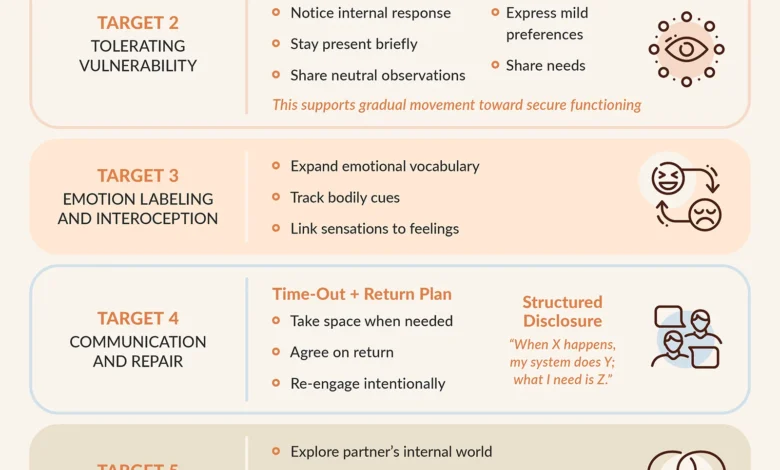
The therapeutic journey often follows a progressive pathway, moving from foundational awareness and regulation towards more complex relational skills and ultimately, earned security. This pathway involves:
- Awareness & Regulation: Helping clients identify their deactivation patterns, understand triggers, and develop internal resources for emotional regulation.
- Vulnerability & Expression: Gradually supporting clients to tolerate and express their authentic needs and emotions in a safe relational context.
- Communication & Relational Repair: Developing skills for direct communication, navigating conflict, and engaging in repair processes after ruptures.
- Integration & Earned Security: Fostering a flexible balance between autonomy and connection, where intimacy is experienced as safe and sustainable.
What Not to Do:
Certain well-intentioned approaches can inadvertently reinforce avoidant patterns. Confrontational interventions that frame distance as problematic can evoke shame and deepen withdrawal. Similarly, pushing for emotional immediacy or intensity too quickly can overwhelm the client’s regulatory capacity, leading to disengagement or dropout. It’s crucial to interpret distance as a protective strategy, not a lack of motivation or resistance (Mu, 2025). The ultimate goal is not to foster dependence but to increase flexibility in relating, allowing clients to experience connection as safe without sacrificing their sense of autonomy.
Working with Avoidant Attachment in Couples
In couples therapy, the focus shifts to the relational cycle, where each partner’s responses mutually reinforce the other’s (Johnson et al., 2016). The classic "pursue-withdraw" dynamic is a common manifestation: one partner seeks closeness, while the avoidant partner withdraws to regulate emotional intensity (Overall etal., 2022). The withdrawal is deactivation, while the pursuit is an attempt to restore connection (Bretaña et al., 2022).
Interventions aim to stabilize emotional intensity, normalize both partners’ strategies, and help them operate within a workable window of tolerance (Xu et al., 2025). Building predictable repair patterns, including taking space and conscientiously returning to connection, is vital for fostering more secure relating over time (Bradbury & Bodenmann, 2020).
A practical "time-out and repair script" can be invaluable for couples:

- Name the need for space: "I’m feeling overwhelmed and don’t want to shut down or say something I don’t mean. I need a bit of space to come back more present."
- Create a clear return plan: "Can we pause for about 20 minutes and come back to this at [specific time]?" (Crucially, always specify a return time).
- Regulate during the break: The individual reflects on their internal experience: "What’s happening in my body? What am I trying to move away from? What would help me stay a little more present when I return?"
- Return to the conversation: "Thanks for giving me that space. I think I got overwhelmed earlier and pulled back. I’d like to try again."
- Practice structured reengagement: "When [situation], my system tends to [withdraw/shut down]. What I think I needed was [space/reassurance/slower pace]."
- Acknowledge impact and repair: "I can see that my pulling away may have felt distancing for you, and I’d like to stay more connected, even if I need to take space."
This structured approach allows individuals to regulate themselves while maintaining the integrity of the relationship and conversation, supporting both personal regulation and relational connection.
The Journey Towards Secure Functioning: Embracing "Earned Security"
Movement toward secure functioning is a gradual, capacity-based process, not a sudden transformation (Jaåçzak, 2023). Progress typically involves developing greater emotional awareness, enabling clients to recognize and name their internal experiences without immediately shutting them down. Over time, they cultivate an increased tolerance for closeness, learning to remain present in moments of connection without becoming overwhelmed (Filosa et al., 2024).
Clients also begin to engage more effectively in repair after relational ruptures, returning to conversations rather than retreating entirely. These shifts collectively reflect a move toward more flexible and responsive ways of relating, where autonomy and connection are no longer perceived as oppositional but can coexist in a balanced manner (Jaåçzak, 2023). This outcome is often termed "earned security," signifying a developed ability to experience intimacy without automatically deactivating or suppressing attachment needs, leading to more adaptive and fulfilling relationships.
In conclusion, avoidant attachment style in adults is fundamentally about self-protection in relationships, forged in experiences where emotional care felt unreliable, unsafe, or overwhelming. What appears as distance or disinterest is, in fact, a learned strategy for maintaining emotional safety and control. Approaching these patterns with curiosity, rather than judgment, allows for a more compassionate and effective therapeutic path. With appropriate pacing, enhanced self-awareness, and consistent relational experiences within and outside of therapy, individuals can gradually soften these protective strategies. This empowers them to cultivate a more flexible way of relating, where their need for autonomy and their desire for connection can harmoniously coexist, leading to relationships that are both secure and sustainable. Susan McGarvie, a therapist and mindfulness practitioner specializing in emotional regulation and compassionate care, emphasizes this shift in perspective as crucial for sustainable professional practice and client well-being.