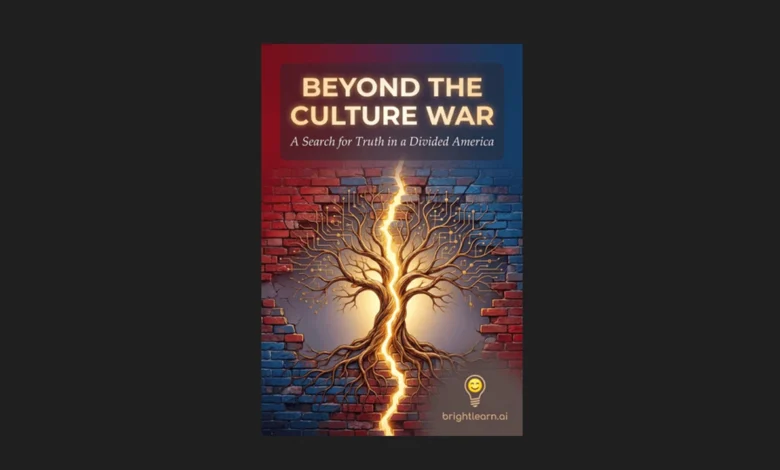
A new book, "Beyond the Culture War: A Search for Truth in a Divided America," posits that the pervasive and often vitriolic conflicts engulfing American society over issues of race, gender, and politics are not organic eruptions of popular sentiment. Instead, the author argues, these divisions are meticulously orchestrated, forming a "well-funded machine" designed to maintain societal fragmentation while preserving the entrenched power of an elite class. This manufactured conflict, characterized as a "hate factory," allegedly serves the interests of various powerful entities, including the military-industrial complex, the pharmaceutical industry, and the political establishment, all of whom, according to the book’s premise, benefit from a population characterized by stress and distraction. The underlying strategy, the book contends, is an age-old tactic: "divide and conquer."
The book advocates for a fundamental shift in individual approach, urging readers to transcend tribal loyalties and embrace independent critical thinking as the primary mechanism for liberation from this perceived trap. It asserts that much of the animosity fueling these societal rifts is actively "manufactured by institutions that profit from division," explicitly naming government, media, and the education system as key perpetrators. The initial and most crucial step, according to the text, is a commitment to questioning all information, regardless of its source. This includes critically evaluating claims presented by established media outlets, whether from CNN, Fox News, or even one’s own ideological camp. The book discourages reliance on curated summaries, instead emphasizing the importance of seeking out primary sources. This includes consulting original documents, unedited speeches, and raw data to gain a comprehensive understanding of context, as "mainstream outlets often spin the truth by removing context."
Unmasking the Distraction of the Political Divide
A cornerstone of this approach to critical engagement, as outlined in "Beyond the Culture War," is the deliberate practice of listening to dissenting voices. While acknowledging that this can be an uncomfortable undertaking, the book asserts its indispensability for intellectual growth. The objective of engaging with opposing viewpoints is not necessarily immediate conversion, but rather a rigorous testing of one’s own deeply held beliefs. The text warns that individuals who exclusively consume media that validates their existing perspectives risk becoming ensnared in an echo chamber, reinforcing their biases and hindering genuine understanding.
Furthermore, the book stresses the necessity of independently identifying and defining personal values, disentangling them from the labels and narratives imposed by external systems. By focusing on fundamental principles such as freedom, family, and community, individuals can establish a personal framework of what truly matters, a standard that is less susceptible to manipulation through simplistic slogans or fear-based campaigns. The text champions "intellectual humility" as the bedrock of independent thought, defining it as the willingness to acknowledge one’s errors and the courage to admit, "I don’t know."
The book highlights the significant personal challenge involved in resisting the pervasive pressure to conform to groupthink. It paints a picture of "the loneliest place in America" as the interstitial space between polarized ideological tribes, a space where independent thought can truly flourish. This path, the book concedes, often invites criticism and attack from both sides of the divide, but it is presented as the necessary price for achieving intellectual and personal freedom. The alternative, it suggests, is a far more undesirable state: remaining a passive participant, or "puppet," in a conflict that is not of one’s own making.
The central thesis of "Beyond the Culture War" is that the dominant political factions in the United States, despite their outward animosity, ultimately serve the interests of the same overarching elite. The culture war, in this view, functions as a strategic distraction, diverting public attention away from critical issues such as monetary policy, the persistent nature of foreign interventions, and the gradual erosion of civil liberties. True freedom, the book concludes, is not found in aligning with a different ideological tribe, but in developing the capacity to discern the underlying mechanisms of manipulation and recognize that the only allegiance truly worth holding is to the pursuit of truth, even when that pursuit entails significant personal sacrifice.
The book is available for purchase through a direct link, and the platform Books.BrightLearn.AI offers a wider selection of literary works, with plans to expand its collection. This decentralized platform also empowers users to create and share their own content, fostering a community for the dissemination of insights and knowledge.
Contextualizing the Culture War Narrative
The concept of a "culture war" in American politics is not new. It gained significant traction in the late 20th century, often used to describe deep societal divisions concerning values, morality, and lifestyle choices. Historically, these conflicts have manifested in debates over issues such as abortion rights, LGBTQ+ rights, the role of religion in public life, and educational curricula. Academics and commentators have often pointed to the polarization of political parties and the fragmentation of media landscapes as contributing factors to the intensification of these culture wars.
The argument presented in "Beyond the Culture War" resonates with critical analyses that examine how societal divisions can be leveraged for political and economic gain. For instance, research into political polarization has explored how campaign strategies and media narratives can amplify existing societal cleavages to mobilize specific voter bases. Data from organizations like the Pew Research Center has consistently shown increasing partisan animosity and divergence in policy preferences among Americans over the past several decades, providing a backdrop against which the book’s thesis can be considered.
The "Hate Factory" Hypothesis: A Deeper Dive
The book’s assertion that a "well-funded machine" is actively manufacturing division warrants a closer examination of potential mechanisms. This hypothesis suggests that sophisticated, organized efforts are at play, employing tactics designed to inflame passions and solidify group identities. Such tactics could include:
- Strategic Media Messaging: The selective amplification of divisive narratives and the creation of "us vs. them" mentalities through news reporting, social media campaigns, and opinion pieces. This can involve framing complex issues in simplistic, emotionally charged terms.
- Algorithmic Amplification: Social media algorithms, designed to maximize user engagement, can inadvertently or intentionally promote content that is sensational, controversial, or emotionally provocative, thereby exacerbating divisions.
- Astroturfing and Disinformation Campaigns: The creation of artificial grassroots movements and the dissemination of false or misleading information to manipulate public opinion and sow distrust.
- Exploitation of Grievances: Identifying and amplifying existing societal grievances, whether real or perceived, to create a sense of victimhood and foster resentment towards opposing groups.
The book’s linkage of these phenomena to profit motives for specific industries, such as the military-industrial complex and the pharmaceutical industry, taps into long-standing critiques of how certain economic sectors might benefit from societal instability or widespread anxiety. A heightened state of societal tension can, for example, lead to increased demand for security measures, surveillance technologies, or even certain types of medical interventions and treatments for stress-related conditions.
The Path to Independent Thought: Practical Implications
The book’s prescription for escaping this perceived cycle of manufactured conflict centers on developing robust critical thinking skills and cultivating intellectual independence. The emphasis on seeking primary sources, for instance, aligns with principles of investigative journalism and academic research. This involves a commitment to:
- Source Verification: Cross-referencing information from multiple, diverse sources to identify potential biases and inconsistencies.
- Contextual Analysis: Understanding the historical, social, and political context in which information is presented.
- Logical Reasoning: Evaluating arguments based on their logical coherence and the strength of the evidence presented.
- Emotional Regulation: Recognizing and managing one’s own emotional responses to information, particularly when it touches on sensitive or polarizing topics.
The call for intellectual humility is also a critical component. In an era where certainty is often prized, the willingness to admit the limits of one’s knowledge and to be open to revising one’s beliefs is a vital safeguard against dogmatism. This can involve actively seeking out perspectives that challenge one’s own, not to be persuaded, but to understand the full spectrum of arguments and to refine one’s own position through rigorous self-examination.
Broader Impact and Implications
The implications of the book’s thesis, if widely accepted, could be profound. It suggests a need for a fundamental re-evaluation of how information is consumed and disseminated, and how societal discourse is shaped. A society that successfully transitions from tribal loyalty to independent critical thinking would likely exhibit:
- Reduced Polarization: A diminished capacity for manufactured divisions to drive wedges between groups.
- Increased Civic Engagement on Substantive Issues: A shift in focus from symbolic cultural battles to the actual policy challenges facing the nation.
- Greater Resilience to Disinformation: A population better equipped to identify and resist manipulation.
- Enhanced Democratic Processes: A more informed and discerning electorate capable of making decisions based on evidence and reason.
However, the path outlined by the book is not without its challenges. The "loneliest place in America" – the space between tribes – is indeed a difficult position to occupy, often subject to criticism from all sides. The book acknowledges this as the "price of freedom," suggesting that the pursuit of truth requires a willingness to stand apart and to endure the discomfort that often accompanies independent thought in a polarized environment.
The book’s ultimate message is one of empowerment, suggesting that individuals possess the agency to break free from manipulative forces by cultivating their critical faculties and prioritizing truth over tribal affiliation. The call to action is not to abandon engagement, but to engage with a heightened level of awareness and a commitment to genuine understanding, recognizing that the most significant battleground may not be the political arena, but the internal landscape of the individual mind.