The practice of partner-assisted stretching has evolved from traditional therapeutic massage and physical therapy modalities into a mainstream wellness activity designed to enhance physical mobility and social connectivity. By utilizing a second person to provide external leverage, resistance, or support, individuals are often able to access ranges of motion that are physically impossible to achieve independently. This collaborative approach to physical recovery has gained significant traction in recent years, particularly as sedentary office work and digital-device dependency have led to widespread musculoskeletal tension.
The mechanics of partner stretching rely on the principles of assisted proprioceptive neuromuscular facilitation (PNF). By integrating a base—the individual providing stability or leverage—and a recipient, the body can move into deeper states of relaxation and elongation. Experts in kinesiology note that the effectiveness of these stretches is heavily dependent on clear communication and the ability to maintain controlled, gradual pressure to avoid overextension of connective tissues.
The Rise of Collaborative Wellness Trends
The integration of social interaction into physical fitness routines is not a new concept, but its application in the realm of deep stretching has seen a distinct increase in popularity since 2020. Data from the Global Wellness Institute suggests that activities emphasizing "connected fitness" have grown by approximately 15% annually as individuals seek to mitigate the physical repercussions of prolonged desk work.
Modern office environments often necessitate hours of sustained flexion, leading to what clinicians describe as "upper-crossed syndrome." This condition, characterized by rounded shoulders and a forward-tilted head, has become a primary target for physical therapists and fitness professionals. Partner-assisted protocols have emerged as a pragmatic intervention to address these postural imbalances by utilizing gravity and external force to counteract the physiological "slump" caused by desk-bound occupations.
Technical Protocols for Assisted Mobility
The implementation of partner stretching requires a structured approach to ensure safety and physiological benefit. The process involves three distinct movements designed to target the upper body, spine, and thoracic cavity.
1. Front-Body Extension and Spinal Realignment
The primary movement, often referred to as the seated thoracic opener, targets the pectoral muscles and the anterior deltoids. By utilizing a seated base, the recipient—positioned on the floor—is able to have their arms extended upward, creating a longitudinal pull that decompresses the thoracic spine. Clinical observations indicate that when done with consistent, slow breathing, this movement promotes parasympathetic nervous system activation, which is critical for muscle fiber relaxation.
2. Upper Back and Thoracic Mobilization
Addressing the upper back requires a calculated application of pressure. In a back-to-back seated configuration, the base acts as a fulcrum. By applying low-to-medium pressure to the upper thoracic region—avoiding the cervical and lumbar spine—the base assists the recipient in opening the chest cavity. This movement mimics the benefits of traditional yoga postures, such as the Cow Pose, but utilizes the base’s body weight to reach deeper into the rhomboids and trapezius muscles.
Research into manual therapy suggests that targeted pressure on these regions can help release myofascial restrictions that accumulate during long periods of sustained posture. Additionally, the inclusion of a secondary pressure-point release at the lumbar junction, performed via the base’s feet, serves to stimulate blood flow to the lower back, an area notorious for chronic stiffness.
3. Full-Body Dynamic Suspension
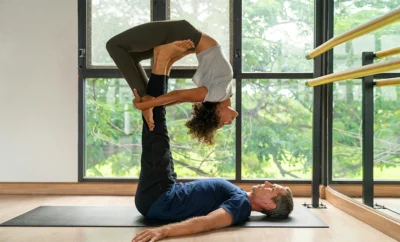
The most advanced maneuver involves an active-passive engagement, often referred to as "flying" in therapeutic yoga circles. In this scenario, the base reclines and utilizes their lower extremities to lift the recipient. This requires the base to engage the quadriceps and core muscles for stability, while the recipient benefits from a gravity-assisted spinal traction. This movement represents a convergence of strengthening for the base and flexibility training for the recipient, making it a high-utility exercise for those with advanced body awareness.
Chronology of Physical Wellness Integration
The formalization of these techniques into the public sphere can be traced through the following timeline:
- 2015–2018: The initial emergence of partner-assisted yoga and assisted stretching clinics in major metropolitan hubs, catering primarily to athletes and high-performance professionals.
- 2019–2021: The pivot toward home-based fitness due to global health mandates, which accelerated the demand for accessible, equipment-free stretching protocols that could be performed with household members.
- 2022–2024: The widespread adoption of video-based tutorials, allowing for the standardization of safety protocols for non-professional practitioners.
- 2025–2026: Integration of these practices into workplace wellness programs and corporate health initiatives aimed at reducing repetitive strain injuries.
Implications for Workplace and Domestic Health
The broader impact of these routines extends beyond simple flexibility. From a physiological standpoint, regular stretching interventions are linked to a reduction in cortisol levels and an improvement in overall circulation. When performed with a partner, the psychological benefit of social bonding acts as a secondary layer of stress mitigation.
However, medical professionals advise that the efficacy of these exercises is predicated on strict adherence to safety guidelines. The "no-pain" rule remains the standard; any discomfort beyond the feeling of a healthy stretch is a clinical indicator that the pressure is too aggressive. The necessity of a "check-in" loop between partners is not merely a social courtesy but a biomechanical requirement to prevent ligamentous strain.
Safety Considerations and Professional Guidance
While partner stretching is accessible to most individuals, specific populations should exercise caution. Individuals with pre-existing spinal conditions, such as herniated discs, scoliosis, or osteoporosis, are advised to consult with a physical therapist before attempting any assisted stretching. The mechanical leverage provided by a partner can inadvertently exacerbate underlying structural vulnerabilities if the base is not properly trained in anatomical limitations.
Furthermore, the "base" partner must be physically capable of supporting the "flier" in more complex movements. The risk of falls or joint dislocation, while statistically low, increases when there is a significant disparity in body mass or strength between participants. Consequently, the industry shift is currently trending toward "low-impact" assisted stretching, which prioritizes ground-based movements over those that require lifting or vertical suspension.
Conclusion: The Future of Collaborative Mobility
As society continues to grapple with the long-term effects of sedentary digital lifestyles, the role of collaborative physical care will likely continue to expand. The shift from solitary gym-based workouts to integrated, partner-centric recovery modalities signifies a maturing approach to personal health. By combining the benefits of physical traction with the social and emotional stability of human connection, partner stretching provides a multifaceted solution to the modern epidemic of physical rigidity.
For those looking to incorporate these routines, the recommendation remains consistent: start with slow, communication-heavy movements, prioritize the comfort of the recipient, and maintain a focus on the physiological goal of the stretch rather than the visual aesthetic of the pose. With these parameters, the integration of partner stretching can serve as an effective, low-cost, and highly rewarding component of a holistic health regimen.