The desire to extend human healthspan and lifespan has moved from the fringes of scientific inquiry to the center of mainstream wellness culture. As individuals increasingly seek to outlive their peers and fend off chronic diseases into their 90s and beyond, a surge in "optimization" culture has emerged. Promoted by high-profile figures such as Dr. Peter Attia, Dr. Andrew Huberman, and biohacker Bryan Johnson, this movement emphasizes a meticulous, often expensive, and highly complex approach to health. However, recent data and expert consensus suggest that the pursuit of a "perfect" health protocol often yields diminishing returns, creating a significant gap between the reality of longevity science and the trends dominating social media feeds.

The Evolution of Longevity Science
The modern focus on longevity—or the study of life extension—is rooted in decades of geriatric and preventative medicine research. Historically, the primary goal of public health was to increase life expectancy by reducing infant mortality and infectious disease. In the 21st century, the focus has shifted toward "healthspan": the number of years an individual lives in good health, free from the chronic illnesses that typically plague the elderly, such as cardiovascular disease, cancer, and neurodegenerative disorders.

In recent years, this field has been accelerated by rapid advancements in genetics, metabolic monitoring, and wearable technology. These tools have allowed for a more granular view of individual biomarkers. However, this precision has also given rise to a "biohacking" industry that frequently conflates theoretical research—often conducted in mice or short-term observational studies—with established clinical practice.
The Reality of the Optimization Plateau

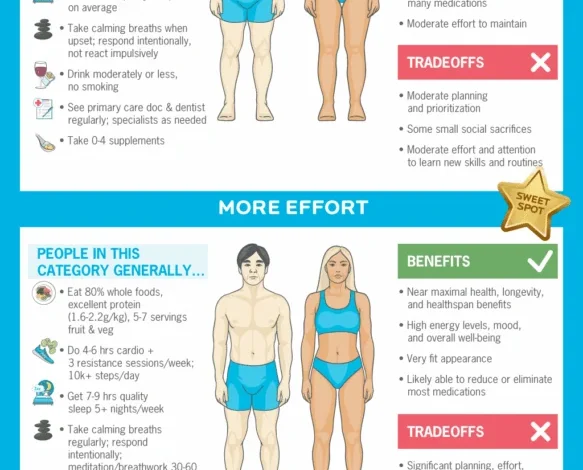
A critical analysis of health behaviors reveals that the relationship between effort and health outcomes follows a U-shaped curve, or a law of diminishing returns. While the shift from a sedentary lifestyle to a moderately active one provides a massive, measurable benefit in mortality reduction, the difference between a high-effort lifestyle and an "extreme" or "optimal" protocol is often marginal.
Data from large-scale health studies consistently demonstrate that consistency in foundational behaviors is the strongest predictor of longevity. For instance, in studies of Harvard alumni and broader population cohorts, physical activity significantly reduces all-cause mortality regardless of genetic predisposition or baseline health. Yet, the greatest gains are observed when individuals reach a "sweet spot" of 7.5 to 15 metabolic equivalent (MET) hours of activity per week. Pushing beyond this, while not necessarily harmful, provides exponentially lower incremental benefits.

The "Basics" vs. The "Biohacks"
The most effective strategy for extending life remains a combination of five core pillars: regular exercise, a nutrient-dense diet, restorative sleep, stress management, and social connection. The challenge, according to public health experts, is not a lack of knowledge regarding these basics, but a lack of consistent execution.

- Physical Activity: The combination of aerobic exercise and resistance training is essential for mitigating the risk of sarcopenia and falls. Research indicates that even modest increases in daily step counts correlate with a 12 percent lower risk of death per 1,000 steps.
- Nutritional Density: Dietary patterns centered on minimally processed whole foods—specifically five daily servings of fruits and vegetables—are linked to significantly lower rates of chronic disease. Current data suggests that the benefits of this consumption level plateau at five servings, meaning excessive intake does not necessarily offer additional longevity advantages.
- Sleep Hygiene: The correlation between sleep duration and mortality is profound. Individuals who consistently sleep 7 to 9 hours per night demonstrate better cognitive function and lower risks of cardiovascular disease. Conversely, long-term sleep deprivation is as detrimental as smoking, with studies showing that men and women who achieve adequate sleep live, on average, several years longer than those who do not.
- Stress Regulation: Chronic stress is a primary driver of inflammation and cardiovascular strain. However, the goal of stress management is not the total elimination of stress—which is a natural part of human existence—but the cultivation of resilience and recovery.
- Social Integration: Perhaps the most overlooked factor is social connection. The Harvard Study of Adult Development, an 87-year-long longitudinal project, identified strong relationships as the single most significant predictor of life satisfaction and longevity, surpassing even wealth and IQ.
The Economic and Psychological Cost of Extremism
The financial and temporal costs of an "optimizer" lifestyle are substantial. When comparing a person who follows evidence-based foundational health behaviors with one who pursues every emerging biohacking trend—including frequent blood panels, specialized supplements, and expensive therapeutic interventions—the "optimizer" often invests three to four times the resources.

Beyond the financial impact, there is a psychological toll. Obsessive monitoring of health markers can lead to orthorexia, anxiety, or a diminished quality of life. The "deep health" model, which integrates social, existential, and emotional well-being alongside physical health, argues that if a health regime compromises one’s ability to enjoy life, it is, by definition, not "optimal."
The Role of Public Health and Socioeconomics

It is necessary to acknowledge that longevity is also heavily influenced by structural factors. The "social determinants of health"—including socioeconomic status, access to quality medical care, and environmental safety—often dictate an individual’s ability to practice these foundational behaviors. For many, systemic barriers make the "basics" difficult to attain. Therefore, the narrative of "optimization" can sometimes ignore the grit and realistic goal-setting required by the average person, instead favoring a narrative of individual perfection that may not be accessible to all.
Moving Forward: A Balanced Perspective

For the general public, the path to long-term health is remarkably simple, if not always easy. The evidence suggests that individuals should:
- Clarify Goals: Distinguish between the desire to maximize every possible minute of life and the desire to live a full, meaningful life.
- Prioritize Consistency: Before investing in fringe supplements or complex protocols, ensure that the basics—sleep, nutrition, movement, and social bonds—are practiced with 80 to 90 percent consistency.
- Be Skeptical of "Noise": Recognize that influencers and podcasters are not medical experts. Before adopting new interventions, consult with healthcare providers and utilize independent research databases like Examine.com or clinical trial repositories.
As the industry continues to evolve, the focus must return to the intersection of clinical evidence and sustainable human behavior. While the allure of "hacking" biology is powerful, the most significant life-extending intervention remains the boring, consistent, and deeply human work of living a balanced, connected, and active life. The goal is not merely to survive for a century, but to ensure those years are marked by vitality rather than a cycle of restrictive, high-cost, and ultimately marginal optimization efforts.
Related posts: