Hidden within the delicate, centuries-old leaves of Europe’s most revered medieval manuscripts lies an extraordinary biological archive that is fundamentally altering our comprehension of veterinary history. An international consortium of researchers, spearheaded by University College Dublin (UCD), has successfully extracted ancient viral DNA from the animal-skin parchment of historical documents. This groundbreaking discovery has unveiled the deep, millennia-old evolutionary history of the sheeppox virus (SPPV), a highly contagious and economically devastating pathogen that continues to plague livestock farming across the globe today.
Published in the esteemed journal Science Advances, the multidisciplinary study bridges the gap between cultural heritage conservation and paleogenomics. By turning libraries and archives into unexpected repositories of disease data, scientists have pushed the recognized timeline of sheeppox back more than 3,500 years. This revelation not only sheds light on the biological landscape of medieval Europe but also offers modern epidemiologists vital clues regarding the genomic stability of capripoxviruses—insights that could prove instrumental in combating contemporary agricultural outbreaks.
The Biological Secret of Medieval Parchment
For centuries, before the widespread adoption of wood-pulp paper in the late medieval and early modern periods, European scribes, scholars, and monastics relied on animal skins to record history, theology, and literature. Known as parchment or vellum, these writing surfaces were meticulously crafted from the pelts of livestock, predominantly sheep, goats, and calves. The production process involved scraping, washing, stretching, and drying the hides, yet it stopped short of destroying the foundational cellular matrix of the skin.
When an animal suffered from a systemic or localized infection at the time of its slaughter, microscopic fragments of pathogen DNA could be permanently trapped within the collagen fibers of the hide. As these manuscripts were preserved in libraries, cathedral archives, and university collections for hundreds—and sometimes thousands—of years, the parchment acted as a stable, dry preservation medium.
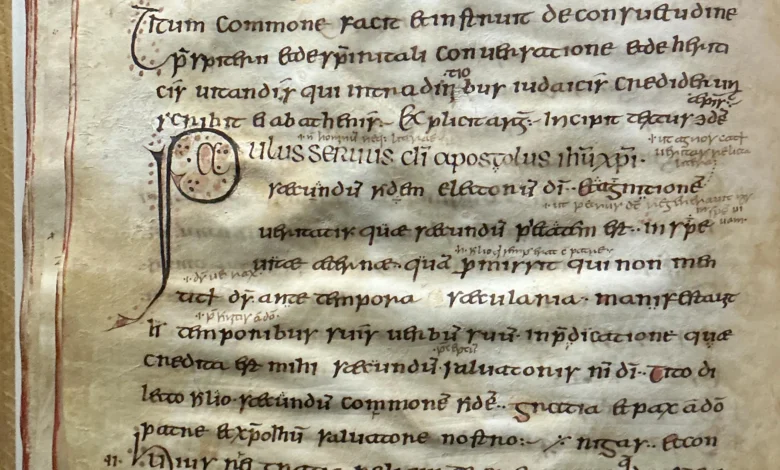
Recognizing this potential, the UCD-led research team subjected several iconic European manuscripts to sophisticated biomolecular screening. Among them was the renowned 1,000-year-old York Gospels, an early Anglo-Saxon illuminated manuscript of immense historical and religious significance. The researchers also analyzed the Corpus Glossary housed at Corpus Christi College, Cambridge—widely recognized as one of the earliest English dictionaries—alongside a curated selection of codices originating from across Britain and continental Europe.
Laboratory analyses confirmed the presence of SPPV DNA spanning multiple pages in several of these documents. The discovery provides undeniable genetic confirmation that animals suffering from active or recent sheeppox infections were utilized in the commercial production of vital medieval texts.
Surprising Detections and Broad Implications
Intriguingly, the research team also identified viral genetic traces on parchment manufactured from calfskin and goatskin. Because sheeppox is conventionally understood to be a strict host-pathogen system primarily affecting sheep (Ovis aries), this finding opened two distinct avenues of scientific interpretation. Either the virus possessed a broader historical host tropism—occasionally crossing the species barrier to infect cattle and goats under pre-modern farming conditions—or the skins became contaminated via cross-contamination during communal processing in active medieval tanneries.
This nuance underscores the complexity of historical livestock management. Louis L’Hôte, a PhD candidate at UCD and lead author of the study, emphasized the paradigm-shifting nature of the methodology.
"The recording of ancient DNA of pathogens has completely changed our understanding of infectious disease in the past, and here we show that parchment can also preserve animal pathogen DNA. It is possible that archives and libraries around the world also contain the genetic traces of disease outbreaks in animals in the past," L’Hôte stated. "These genomes help us understand how these pathogens evolved and how they impacted past societies—such as sheeppox virus, which we show has been affecting Eurasian sheep herds for at least three and a half millennia."
Dr. Kevin G. Daly, Associate Professor at the UCD School of Agriculture and Food Science and the supervising author of the research, highlighted the convergence of traditional craft and modern science.
"Parchment making has been considered a vanishing craft, but we are beginning to understand just how much of the past it has retained. This project shows that parchments not only preserve our cultural history for hundreds of years, but also the landscape of disease in our livestock in the medieval period," Dr. Daly remarked. He further credited the success of the endeavor to collaborative trust across diverse scientific domains, noting that the project integrated specialists in genetics, history, virology, protein chemistry, and conservation.
A Chronology of Contagion: Spanning Millennia
To contextualize the viral signatures recovered from medieval codices, the researchers expanded their temporal scope far beyond the Middle Ages. They investigated genetic material extracted from ancient sheep teeth unearthed at Bronze Age pastoralist settlements across the Eurasian steppe.
Teeth represent an optimal substrate for paleogenomic investigations. Due to their dense mineralization, dental structures naturally protect enclosed DNA from environmental degradation, frequently preserving genetic profiles that vanish from porous skeletal elements or soft tissue remains.
By sequencing the viral DNA recovered from these prehistoric teeth, the team identified the oldest known genetic traces of the sheeppox virus, anchoring its existence in antiquity. When integrated with the medieval manuscript data, the combined timeline demonstrates that SPPV has exerted continuous evolutionary and economic pressure on Eurasian livestock populations for more than 3,700 years.
Furthermore, by comparing these ancient viral genomes with contemporary strains, the researchers constructed a molecular clock to estimate the divergence dates of the broader capripoxvirus genus. Their phylogenetic analysis indicates that the primary viral lineages—comprising sheeppox virus, goatpox virus, and lumpy skin disease virus—diverged from a common ancestor roughly between 11,500 and 3,700 years ago.
This chronological window aligns remarkably well with major socio-economic transitions in human prehistory, most notably the domestication of hoofed livestock and the subsequent large-scale migration of pastoral communities and sheep herds from the Eurasian steppe into central and western Europe. These historical human-driven migrations likely served as the primary vector for the geographic dissemination and diversification of capripoxviruses.
Genomic Stability and Modern Veterinary Realities
One of the most astonishing revelations of the study is the pronounced genetic stability of the sheeppox virus over millennia. While many common viral pathogens—such as influenza or SARS-CoV-2—exhibit rapid mutation rates that continuously alter their virulence and antigenicity, the SPPV genome has remained remarkably conserved across thousands of years.
Unlike the human smallpox virus (Variola virus), which underwent significant evolutionary shifts and selective pressures associated with human demographics, the sheeppox genome appears to have reached a localized evolutionary equilibrium long before the written record of the Middle Ages.
This deep stability provides critical context for contemporary veterinary medicine. Sheeppox remains a Class A notifiable animal disease in many jurisdictions, capable of inducing mortality rates of up to 50% in naive flocks, alongside severe reductions in wool, meat, and dairy yields. Modern agricultural sectors continue to expend substantial resources on quarantine protocols, movement restrictions, and vaccination campaigns to suppress sudden epizootics.
Highlighting the enduring relevance of the research, L’Hôte pointed to ongoing agricultural crises in Europe. "People around the world are still fighting against this pathogen—there is currently an outbreak of sheeppox in Greece, causing much economic damage," he noted.
By mapping the historical trajectory of the virus, scientists hope to isolate the specific genetic adaptations that enabled the pathogen to successfully colonize its ovine host in prehistory. Understanding these ancient mutations could illuminate new pathways for developing next-generation vaccines or therapeutics to protect global livestock industries.
Collaborative Framework and Future Horizons
The scale and depth of the investigation reflect a massive interdisciplinary mobilization. Funded jointly by Taighde Éireann-Research Ireland and the European Research Council, the project united over 30 academic and research institutions. Key collaborators included Trinity College Dublin, the Helmholtz Institute for One Health, Université Paris 1 Panthéon-Sorbonne, the University of Leicester, the University of Cambridge, and the University of Copenhagen.
By demonstrating that cultural artifacts can serve as biological time capsules, this landmark study opens an entirely new frontier in paleopathology. Archivists, conservators, and geneticists now face the exciting prospect that institutional libraries worldwide may hold thousands of uncatalogued microbial histories. As analytical techniques in ancient DNA extraction continue to advance, the written heritage of human civilization may increasingly double as a comprehensive library of planetary ecological and epidemiological memory.
Related posts: