What does it truly mean to live a good life? This fundamental question has increasingly occupied psychologists and social scientists, leading to the emergence of "flourishing" as a comprehensive concept of well-being. Flourishing extends far beyond transient happiness or material success, encompassing an individual’s entire life in relation to their social fabric and community. In a significant re-evaluation of conventional development narratives, new research sheds light on how African populations experience and define flourishing, challenging long-held assumptions and offering profound insights for global well-being studies.
The Evolving Concept of Flourishing: A Multidimensional Lens
For decades, the global discourse on development and quality of life has predominantly hinged on economic indicators such as Gross Domestic Product (GDP) per capita. While these metrics offer a snapshot of economic activity, they often fail to capture the intricate tapestry of human experience, social cohesion, and individual fulfillment. The concept of flourishing, rooted in ancient philosophies like Aristotle’s eudaimonia and revitalized by modern positive psychology, offers a more holistic framework. It posits that a good life involves not just feeling good, but also functioning well across multiple domains.
Psychological scientist Victor Counted, whose extensive research across 40 African countries provides a data-rich re-thinking of flourishing on the continent, emphasizes this multidimensionality. He explains that flourishing is "more than economic growth or individual happiness. It’s a multidimensional state of being that reflects how people feel about their lives and how well their lives are actually going." Crucially, it integrates an individual’s values within their community and environment, moving beyond the often Eurocentric emphasis on personal satisfaction, autonomy, and individual achievement. Flourishing, in this context, encompasses the social, spiritual, and ecological dimensions of life, recognizing that a person’s well-being is inextricably linked to their relationships with others and the world around them. This holistic view is particularly pertinent in diverse cultural contexts, where communal bonds and spiritual beliefs often play a central role in defining a meaningful existence.
The Global Flourishing Study: Initial Insights from Africa
The Global Flourishing Study (GFS) represents a monumental effort to quantify and understand human flourishing worldwide. This ambitious five-year longitudinal study involves over 200,000 participants across 22 countries, aiming to identify global patterns of well-being across diverse cultures and life circumstances. Victor Counted was part of the team of global scholars contributing to this extensive project.
The GFS measures flourishing across six key dimensions:
- Happiness and Life Satisfaction: Reflecting subjective well-being and overall contentment.
- Mental and Physical Health: Encompassing emotional stability, absence of illness, and vitality.
- Meaning and Purpose: The sense that one’s life has significance and direction.
- Character and Virtue: Qualities like honesty, kindness, forgiveness, and resilience.
- Social Relationships: The quality and depth of one’s connections with family, friends, and community.
- Financial and Material Stability: Access to resources that meet basic needs and provide security.
Participants rate their experiences in each area on a scale from 0 to 10, with additional questions probing related well-being variables such as trust, loneliness, hope, and resilience.
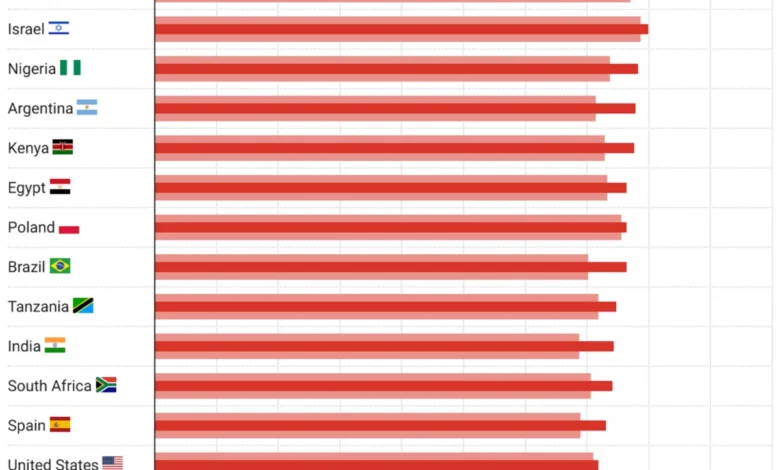
Of the 22 nations included in the GFS, five were African: Nigeria, Kenya, South Africa, Tanzania, and Egypt. While the overall global rankings saw Indonesia and Mexico emerge at the top, the African nations presented a nuanced and often surprising picture. Notably, Nigeria, Kenya, and Egypt reported relatively high flourishing scores, particularly when financial status was excluded from the assessment. This distinction is critical, as it highlights the presence of robust well-being even in the face of economic challenges.
For instance, Nigeria ranked an impressive fifth globally in flourishing scores that specifically excluded financial indicators, surpassing many wealthier nations. Nigerians demonstrated significant strengths in social relationships, character, and virtues, such as forgiveness and altruism. However, the study also identified areas for potential growth, including financial well-being, housing security, experiences of ethnic discrimination, and educational access. These findings underscore that while material resources undoubtedly contribute to a good life, they are not the sole determinants of well-being. Kenya followed, ranking seventh, with Egypt at tenth, Tanzania at eleventh, and South Africa at thirteenth. Each of these countries showcased unique strengths in domains like meaning, social connection, or mental health, illustrating the diverse pathways to flourishing within the continent. This initial phase of the GFS laid the groundwork for a deeper, more culturally attuned exploration of African well-being.
Victor Counted’s 2024 Study: An Intracontextual African Perspective
Building upon the GFS, Victor Counted conducted a separate, more focused 2024 study that analyzed data from the Gallup World Poll (2020–2022) across 40 African countries. This intracontextual research aimed to provide a detailed and culture-sensitive understanding of how Africans experience and prioritize flourishing, moving beyond a purely global comparative lens. The study incorporated 38 indicators of well-being, carefully derived from both local African and universal sources to ensure regional relevance.
The findings from this extensive African-centric study offered a powerful corrective to the prevailing Western narrative that often portrays Africa as "lagging behind" in development. Counted’s research unequivocally demonstrated that African populations frequently score high in dimensions such as meaning, character, and social relationships, often despite significant economic hardship. This challenges the deeply ingrained assumption that economic prosperity is a prerequisite for a fulfilling life, suggesting that alternative forms of capital – social, cultural, and spiritual – play a profound role in African well-being.
The results reinforced the critical insight that flourishing in Africa cannot be reduced solely to GDP per capita or to Western norms of success. This is a crucial distinction, as it advocates for development models that recognize and build upon the inherent strengths and unique cultural values of African societies, rather than imposing external benchmarks. The study illuminated that the fabric of African communities often weaves together strong social bonds, deep spiritual connections, and a resilient sense of purpose, which collectively contribute to a robust sense of flourishing irrespective of material wealth.
Implications for Development Policy: A Call for Indigenous Pathways
The insights from Counted’s research provide a compelling roadmap for African countries to foster greater flourishing, advocating for an approach that embraces local knowledge and prioritizes culturally relevant development. This path diverges from traditional Western models, which often center on individual advancement and material accumulation, by proposing alternative pathways rooted in African values.
-
Prioritizing Local Knowledge Systems: Counted emphasizes the immense value of African indigenous knowledge systems. Concepts such as ubuntu (Southern Africa), which translates to "I am because we are," highlighting interconnectedness and compassion; ujamaa (East Africa), a Swahili term for familyhood and cooperative economics; teranga or wazobia (West Africa), representing hospitality and communal solidarity; and al-musawat wal tarahum (North Africa), emphasizing equality and mercy, are not mere cultural artifacts. They are living philosophies that teach mutual care, peaceful coexistence, and community responsibility. These profound values, deeply embedded in societal structures, can and should inform contemporary leadership, policy-making, and legislation, fostering a governance framework that resonates with the innate aspirations of African people. Integrating these principles into national development strategies can lead to more sustainable and culturally appropriate solutions, strengthening social cohesion and collective well-being.
-
Redefining Development Metrics: The reliance on GDP per capita as the primary measure of national progress has long been criticized for its inability to capture human dignity, environmental sustainability, and social equity. Counted advocates for a paradigm shift, urging a move beyond narrow economic indicators to a more comprehensive set of metrics. This includes measuring subjective well-being (happiness), future orientation (hope), community strength and resilience, and the quality of living environments (cleanliness, safety, dignity). This is not a novel concept; development scholars and international organizations have for years called for a broader understanding of progress. The Human Development Index (HDI), for example, developed by the UN, incorporates life expectancy, education, and per capita income. Bhutan’s Gross National Happiness (GNH) index takes this further, including psychological well-being, ecological diversity, and cultural vitality. What is new, however, is the growing availability of robust data, exemplified by studies like the GFS and Counted’s African research, which provides the momentum to seriously integrate these alternative metrics into national policies and priorities. By adopting such holistic measures, African nations can better track progress towards outcomes that truly matter to their citizens.
-
Investing in Education for Character Development: Quality education is undeniably a cornerstone for unlocking Africa’s vast potential. However, Counted argues that an exclusive focus on academic skills and workforce readiness falls short. Africa needs a strategic investment in intentional character development, fostering values and habits that shape ethical thought, responsible action, and integrity. This involves recognizing the critical role of the humanities – fields like history, literature, philosophy, and religious studies – which are often undervalued or underfunded in many educational systems. These disciplines are vital for nurturing moral imagination, critical reflection, and civic responsibility. Educational models must evolve to form not just skilled workers, but "whole persons" – individuals capable of ethical reasoning, responsible leadership, and active, positive participation in their communities. Such an approach builds resilience, promotes social harmony, and equips future generations to navigate complex challenges with wisdom and integrity.
Africa’s Offer to the World: A Paradigm of Wholeness and Resilience

The narrative of Africa as a continent perpetually "waiting to be saved" or defined by its deficits is fundamentally challenged by these findings. Instead, Counted’s research positions Africa as a fount of wisdom and an alternative vision for global development. Across its diverse landscapes, communities are actively building robust networks of care, cultivating joy amidst adversity, and preserving invaluable traditions of unity, faith, and compassion. This, Counted asserts, is what truly dignified and human-centered development looks like.
Africa’s flourishing goals are locally emic aspirations for well-being, deeply rooted in its indigenous knowledge systems, rich cultural values, and diverse religious and spiritual traditions. Pursuing these goals means prioritizing wholeness over wealth, community over consumption, and resilience over external rescue. In a world grappling with the paradox of material abundance alongside pervasive mental health crises and social fragmentation, Africa offers profound lessons. Its emphasis on strong communal bonds, spiritual fortitude, and the capacity to find meaning and connection even in difficult times provides a powerful counter-narrative to the individualistic, consumption-driven models prevalent in many developed nations.
The wisdom embedded in African ways of life – from the interconnectedness of ubuntu to the hospitality of teranga – represents a vast, untapped resource for the global science of well-being. By embracing these local insights, the international community can move towards a more inclusive and nuanced understanding of what constitutes a truly good and flourishing life for all humanity, recognizing that the pathways to well-being are as diverse and rich as the cultures that embody them.
Challenges and the Path Forward
While the research highlights remarkable strengths, it is crucial to acknowledge the persistent challenges that many African nations face, including poverty, political instability, conflict, governance issues, and the impacts of climate change. These realities undeniably affect flourishing. However, Counted’s work reframes these challenges not as insurmountable obstacles, but as opportunities for uniquely African solutions. By leveraging the inherent strengths identified – strong social relationships, character, meaning, and resilience – African communities can develop robust, context-specific strategies to address these issues.
The path forward involves fostering international collaboration that is grounded in mutual respect and learning, rather than the imposition of one-size-fits-all development models. It requires empowering local institutions, supporting indigenous research, and integrating traditional knowledge with modern approaches to create holistic development strategies. As the global conversation around well-being continues to evolve, Africa stands ready to offer not just a different perspective, but a vital blueprint for a more humane, interconnected, and ultimately more flourishing world.