MIT Bioengineers Pioneer In Vivo Nanoparticle Technique to Transform Immune Cells Into Cancer-Destroying Agents Directly Inside the Human Body

In a groundbreaking development that could fundamentally reshape the landscape of modern oncology and immunology, researchers at the Massachusetts Institute of Technology (MIT) have engineered a revolutionary technique to reprogram immune cells directly inside a living organism. Published in the prestigious peer-reviewed journal Nature Biotechnology, the study details a novel method utilizing lipid-based nanoparticles to deliver precise genetic instructions straight to natural killer (NK) cells. By bypassing the complex, lengthy, and prohibitively expensive ex vivo manufacturing processes that currently plague personalized cell therapies, this breakthrough hints at a future where advanced cancer and autoimmune treatments could be administered via a simple outpatient injection.
The research team, spearheaded by senior author Daniel Anderson alongside lead authors Yuang Chen, Julia Monkovic, and Haseeb Mughal, with substantial contributions from Institute Professor Robert Langer, has successfully demonstrated that targeted nanocarriers can instruct a patient’s own natural killer cells to hunt down and eradicate both malignant tumors and rogue cells responsible for autoimmune diseases. As the medical community looks toward the next generation of immunotherapy, this innovative approach addresses some of the most stubborn economic, logistical, and biological bottlenecks facing modern medicine.
The Promise and Perils of Contemporary Immunotherapy
Over the past ten years, the advent of chimeric antigen receptor (CAR) T-cell therapies has delivered nothing short of a medical miracle for certain oncology patients, particularly those battling treatment-resistant hematological malignancies. The U.S. Food and Drug Administration (FDA) has granted approval to seven distinct CAR-T therapies since 2017, transforming prognoses for individuals suffering from specific forms of leukemia, aggressive B-cell lymphomas, and multiple myeloma.
The mechanism behind these approved therapies relies on harvesting a patient’s own T cells, shipping them to specialized biotechnology facilities, and genetically altering them using viral vectors to express customized synthetic receptors. These receptors are specifically programmed to recognize tumor-associated antigens. Once the modified cells are successfully cultivated in vast quantities, they are frozen, transported back to the clinical site, and reinfused into the patient to seek out and destroy cancer cells.
Despite their remarkable clinical efficacy, traditional CAR-T therapies are encumbered by significant structural vulnerabilities. The logistical pipeline required to manufacture these living drugs is exceptionally brittle, labor-intensive, and time-sensitive, often taking several weeks from initial blood draw to final infusion. Consequently, the price tag for a single course of treatment frequently scales into the hundreds of thousands of dollars, placing a heavy financial burden on healthcare systems and limiting global accessibility.
Furthermore, traditional CAR-T approaches face acute biological limitations when applied to T-cell malignancies or autoimmune disorders. Because both the therapeutic CAR-T cells and the targeted diseased cells belong to the same lineage—T cells—engineered cells frequently recognize and destroy one another during the manufacturing and deployment phases. This self-annihilation phenomenon, known as fratricide, severely undercuts the therapeutic potency of the treatment, leaving clinicians with constrained therapeutic windows.
Harnessing Natural Killer Cells to Overcome Biological Barriers
To circumvent the inherent limitations of T-cell therapies, researchers have increasingly turned their attention toward natural killer (NK) cells. As a crucial component of the innate immune system, NK cells possess an intrinsic ability to detect and lyse stressed, virally infected, or malignant cells without requiring prior sensitization.
Crucially, NK cells offer a distinct advantage when targeting pathologies involving dysfunctional T cells. Because they are biologically distinct from T cells, engineered NK cells—known as CAR NK cells—can be programmed to relentlessly hunt down cancerous T cells or autoreactive T cells driving autoimmune hepatitis, multiple sclerosis, or rheumatoid arthritis, entirely avoiding the destructive fratricide trap that plagues CAR-T modalities.
Yet, despite their biological superiority in these contexts, manufacturing CAR NK cells outside the body has historically suffered from many of the same logistical and financial impediments as their T-cell counterparts. The extraction, isolation, viral transduction, and expansion phases still demand pristine cleanrooms, specialized bioreactors, and extensive quality control protocols.
Recognizing these compounding hurdles, the MIT bioengineering laboratory sought to eliminate the laboratory entirely from the equation. Their proposed solution: in vivo reprogramming. By engineering lipid nanoparticles (LNPs) capable of navigating the complex biological milieu of the bloodstream to find and modify NK cells directly inside the body, the researchers realized they could democratize access to advanced cellular therapies. "If a patient can just get an infusion of nanoparticles, it would dramatically simplify the process and reduce costs," notes Daniel Anderson, professor in MIT’s Department of Chemical Engineering and a member of the Koch Institute for Integrative Cancer Research.
Precision Engineering: How Lipid Nanoparticles Reprogram Immunity In Vivo
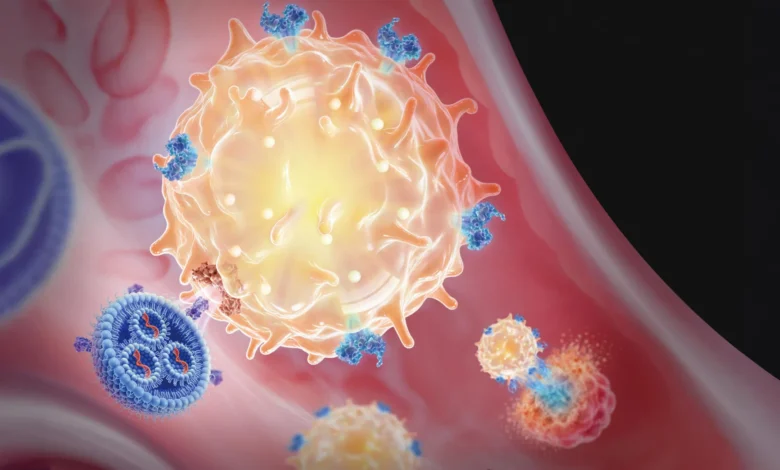
The technological core of the MIT breakthrough rests upon sophisticated chemical design. The research team formulated microscopic lipid nanoparticles tailored to protect messenger RNA (mRNA) cargo from rapid enzymatic degradation in the bloodstream. This fragile mRNA payload carries the precise genetic blueprint for assembling a custom chimeric antigen receptor.
To ensure that the nanoparticles selectively dock with natural killer cells rather than other abundant immune populations like B cells or macrophages, the scientists functionalized the exterior surfaces of the LNPs with specific antibody fragments. These surface markers act as molecular homing beacons, recognizing and binding exclusively to receptors expressed on the membranes of NK cells.
Upon making contact, the nanoparticles are internalized by the target NK cell. Once safely inside the intracellular environment, the mRNA instructions are translated by the cellular machinery, prompting the NK cell to rapidly synthesize and display the specialized chimeric antigen receptors on its surface.
This modular platform is remarkably versatile. By simply swapping out the mRNA sequence within the nanoparticle, researchers can alter the target specificity of the reprogrammed NK cells. For instance, the system can be directed to express receptors targeting CD19, a hallmark protein found on B-cell malignancies, or alternatively, CD3, a surface protein prevalent on T cells driving autoimmune attacks.
Preclinical Validation: Eradicating Tumors and Reversing Autoimmune Damage
To validate the clinical potential of this in vivo reprogramming strategy, the MIT team conducted a rigorous series of preclinical evaluations using advanced murine models. The initial biodistribution and transfection efficiency assays yielded striking results: following a targeted nanoparticle injection, the delivery system successfully modified approximately 80 percent of the targeted natural killer cell population in vivo.
Building upon this high transfection rate, the researchers tested the therapeutic capabilities of the newly minted CAR NK cells in mice bearing aggressive forms of melanoma. In trials tracking survival and tumor progression, three out of five mice treated with the LNP therapy experienced a complete and durable tumor remission.
To evaluate efficacy against human-specific malignancies, the team utilized "humanized" mouse models—rodents engineered with functional human immune systems via cell transfusions. When challenged with aggressive human T-cell lymphoma, mice receiving a regimen of five nanoparticle injections exhibited sweeping tumor destruction, culminating in the total eradication of the cancerous tissue. Remarkably, these therapeutic outcomes matched the efficacy metrics of traditional CAR NK cells manufactured externally in a laboratory setting, confirming that in vivo bioengineering sacrifices none of the potency of classical cell therapies.
Beyond oncology, the researchers expanded their investigation into the realm of autoimmune pathology, targeting autoimmune hepatitis—a debilitating condition characterized by autoreactive T cells systematically attacking healthy hepatocytes in the liver. By designing lipid nanoparticles that programmed NK cells to clear these destructive autoreactive T cells, the team sought to interrupt the cycle of chronic inflammation and tissue damage.
The results surpassed expectations. Following a single nanoparticle injection, the targeted autoreactive T cells were successfully eliminated from circulation. More importantly, histological analyses revealed that the murine liver tissue actively regenerated and healed itself once the pathological immune attack was neutralized. "This study is an excellent example of the power of nano delivery systems and their ability to potentially treat cancer and other diseases," observes Robert Langer, MIT’s David H. Koch Institute Professor and co-author of the study.
Broader Implications and Future Clinical Horizons
While the therapeutic implications of this research are profound, scientific experts emphasize that the transition from murine models to human clinical trials remains a complex, multi-year endeavor. Regulatory bodies such as the FDA will require exhaustive toxicological evaluations, pharmacokinetic profiling, and scalable manufacturing validation to ensure that in vivo nanoparticle delivery maintains an uncompromised safety profile in human patients.
Nevertheless, the long-term economic and clinical ramifications of replacing ex vivo cell processing with injectable nanomedicine cannot be overstated. By converting a complex, weeks-long hospital procedure into a standard intravenous infusion, this technology holds the potential to reduce manufacturing overhead by orders of magnitude, shorten patient wait times, and expand availability to clinics worldwide that lack the specialized infrastructure required for traditional cellular immunotherapies.
Looking forward, the MIT laboratory aims to adapt their nanoparticle platform to target an even wider array of challenging immune-mediated conditions, including multiple sclerosis and rheumatoid arthritis, where aberrant T-cell activity drives chronic neurodegeneration and joint destruction. As funding from institutional partners like the National Cancer Institute, the Marble Center for Cancer Nanomedicine, and industrial collaborators such as Sanofi continues to fuel ongoing development, the scientific community moves steadily closer to realizing a new frontier in precision medicine—one where the body’s own immune system is retrained on demand, from the inside out.