LeBron James Defies Time and Redefines Longevity as He Shatters NBA Field Goal Record at 41

In an era where professional basketball careers are typically defined by a steep physical decline once an athlete enters their mid-thirties, LeBron James continues to operate in a category of his own. Recently becoming the first player in the history of the National Basketball Association to surpass 16,000 made field goals, the Philadelphia 76ers forward has transformed the conversation surrounding athlete longevity. Now in his 24th season, James is not merely participating; he is dominating, proving that his rigorous commitment to mobility, core stability, and neuro-cognitive training is yielding unprecedented results on the hardwood.
The milestone of 16,000 field goals is a testament to two decades of relentless consistency. This record, which further cements his status as the league’s all-time leading scorer, highlights a career defined by durability. Since his debut in 2003, James has navigated the evolution of the NBA—from the grit-and-grind defensive era of the mid-2000s to the high-pace, perimeter-oriented game of today—without sacrificing his efficiency or his ability to dictate the flow of a contest.
The Anatomy of an Elite Training Regimen
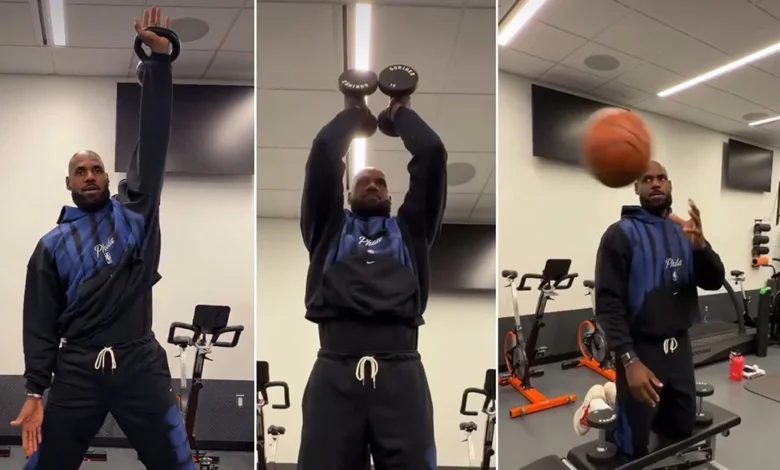
The recent viral footage disseminated by the NBA’s official social media channels provides a rare, transparent look at the mechanics behind James’s sustained performance. The video, captured just days before his regular-season debut with the Philadelphia 76ers, serves as a masterclass in functional fitness for aging athletes.
Central to his routine is a focus on time-under-tension (TUT) movements designed to fortify the upper body while maintaining joint health. A standout sequence involves a complex shoulder press variant. James utilizes a pair of dumbbells to initiate a standard overhead press, but the movement evolves into an elbow squeeze at the apex, forcing the pectoral and deltoid muscles to remain engaged throughout the transition. By slowly lowering the weight and incorporating a rear-delt fly, James addresses the posterior chain, a critical area for injury prevention in basketball players who are prone to shoulder instability due to the repetitive motion of shooting and defending.
Beyond raw strength, the training emphasizes mobility drills that integrate core engagement with rotational power. By utilizing kettlebells to stretch the obliques while performing controlled movements, James ensures that his midsection—the engine of every jump shot and defensive slide—remains resilient against the physical toll of an 82-game season.
Neuro-Cognitive Training and Reaction Drills
One of the most compelling aspects of James’s off-court preparation is his reliance on neuro-cognitive drills, which aim to sharpen his reaction times beyond the traditional confines of cardiovascular training. In one notable exercise, James is seen kneeling on a bench, a position that effectively isolates the upper body and challenges his balance. While in this unstable state, he is tasked with catching basketballs thrown to his periphery by a training partner.
This drill is not merely about hand-eye coordination; it is about cognitive load management. Scientific literature suggests that by decoupling physical performance from lower-body reliance, athletes can significantly improve their reaction speed and decision-making capabilities under pressure. When the brain is forced to process visual stimuli while the body is in an unstable position, the resulting neuromuscular adaptations often translate into faster "court vision" during live gameplay. For James, this means that even if his raw athleticism wanes slightly due to age, his ability to read a passing lane or react to a deflection remains at an elite, youthful level.
Chronology of a Record-Breaking Career
To understand the magnitude of James reaching 16,000 field goals, one must view the timeline of his career through the lens of sheer volume and sustained excellence.
- 2003: Drafted first overall by the Cleveland Cavaliers, marking the beginning of a legacy built on immediate impact.
- 2010–2014: The Miami Heat era, where James refined his efficiency, recording some of his highest shooting percentages while developing into a more versatile playmaker.
- 2016: The historic comeback in the NBA Finals against the Golden State Warriors, demonstrating his ability to carry a franchise through extreme physical adversity.
- 2023: Surpassing Kareem Abdul-Jabbar for the NBA’s all-time scoring record, a milestone that moved the goalposts for what is considered "unbreakable" in sports.
- 2026: Reaching the 16,000 field goal threshold with the Philadelphia 76ers, signaling that his 24th season is not a victory lap, but a continuation of his competitive peak.
The transition to the 76ers has been marked by a clear objective: the pursuit of another championship. His public insistence that he did not relocate his life from Los Angeles to Philadelphia to exit the playoffs in the early rounds reflects a player who remains motivated by hardware rather than history books.
Implications for the Modern NBA
The broader implication of James’s performance at age 41 is the shift in how professional organizations view player care. His investment in recovery, nutrition, and personalized training protocols has set a new industry standard. Teams are now more likely to implement "load management" strategies that mirror the meticulous care James has taken with his own body for two decades.
Moreover, James’s success challenges the narrative that professional basketball is an "early-retirement" sport. By demonstrating that cognitive sharpness and mobility are as important as vertical leap, he is providing a blueprint for the next generation of players. Younger stars are now observing that the secret to a long career is not just natural talent, but the discipline to work on the "invisible" aspects of the game—the core stability, the reaction drills, and the mobility routines that prevent the accumulation of micro-injuries.
Statistical Analysis and Performance Metrics
The efficiency of James’s scoring is just as notable as the volume. Despite his age, he maintains a high-percentage shooting profile, largely because his mobility allows him to reach spots on the floor that younger, less disciplined players cannot. His ability to hit shots while under duress—often the result of the "time under tension" training he performs in the gym—is a direct correlation to his current output.
Data analysts have noted that James’s usage rate remains significantly higher than the average for players in their 40s. While most veterans see their minutes restricted to preserve their health, James’s tactical movement—often centered on low-impact, high-efficiency plays—allows him to stay on the floor for extended periods without risking the catastrophic fatigue that typically plagues older athletes.
A Legacy in Motion
As the Philadelphia 76ers continue their campaign in the Western Conference, all eyes are on the man who refuses to succumb to the passage of time. His teammates and coaches have frequently cited his work ethic as the primary catalyst for the team’s current success. In a league that is constantly looking for the "next big thing," LeBron James remains the constant, providing a masterclass in discipline every time he steps into the weight room or onto the court.
The record of 16,000 field goals will eventually be analyzed as a milestone of a bygone era of basketball, but the process that got him there—the kettlebell work, the stability drills, and the unrelenting focus—is timeless. As James continues his 24th season, the basketball world is witnessing a unique phenomenon: an athlete who is not just chasing his past records, but actively rewriting the possibilities of the future. Whether he continues to compete for several more years remains a subject of speculation, but if the current trajectory of his physical conditioning is any indication, the "King" is far from abdicating his throne.