Trucking’s Triple Crisis: Diesel Prices, Regional Scarcity, and the Autonomous Threat

The American freight industry is currently navigating a period of profound volatility, characterized by a convergence of energy market instability, infrastructure degradation, and rapid technological disruption. For the trucking sector—a primary pillar of the U.S. economy responsible for moving approximately 72 percent of the nation’s total freight by weight—these converging pressures have created a climate of widespread economic concern. Reports of organized labor actions and coordinated work stoppages among independent owner-operators and unionized drivers reflect a growing industry-wide frustration regarding operational viability in an era of soaring overhead costs.
The Macroeconomic Impact of Diesel Price Volatility
The most immediate catalyst for the current unrest is the unprecedented escalation in diesel fuel prices. Unlike gasoline, which primarily serves the passenger vehicle market, diesel is the lifeblood of the commercial supply chain. Recent data indicates that the national average price of diesel has risen by approximately 60 percent year-over-year. In specific high-cost markets, such as San Francisco, retail prices have breached the $8.00 per gallon threshold, an occurrence that has fundamentally altered the cost structure of long-haul logistics.
From an economic standpoint, these costs are rarely absorbed by the trucking companies themselves. Due to the thin margins inherent in the freight industry, fuel surcharges are passed directly to retailers and, ultimately, to the consumer. This "hidden tax" on shipping contributes significantly to core inflation metrics, affecting the price of food, medical supplies, and consumer electronics. The average heavy-duty truck fleet in the United States consumes upwards of 2.9 million barrels of diesel per day; consequently, even a marginal increase in fuel costs generates a massive aggregate drag on the domestic economy.
Chronology of Energy Infrastructure Constraints
The current crisis is rooted in a multi-year trend of declining refining capacity and regulatory shifts. Industry analysts point to a series of strategic closures and maintenance-related outages that have tightened supply despite stable, or in some cases, declining demand.
- October 2025: The Phillips 66 Wilmington refinery in California ceased operations, removing approximately 139,000 barrels per day from the state’s supply chain.
- January 2026: The Valero refinery in Benicia, California, closed following a reported $1.1 billion loss, further constricting regional output.
- Late 2026: A series of grid-related failures in the Midwest, most notably at the ExxonMobil Joliet refinery in Illinois, disrupted the flow of roughly 11 million gallons of fuel per day, illustrating the fragility of the nation’s aging refining infrastructure.
These disruptions are exacerbated by geopolitical tensions. Reductions in crude oil shipments from major exporters and ongoing instability in the global energy market have limited the ability of domestic refineries to source sufficient feedstocks, creating a "perfect storm" of scarcity and high pricing.
The Looming Threat of Regional Scarcity
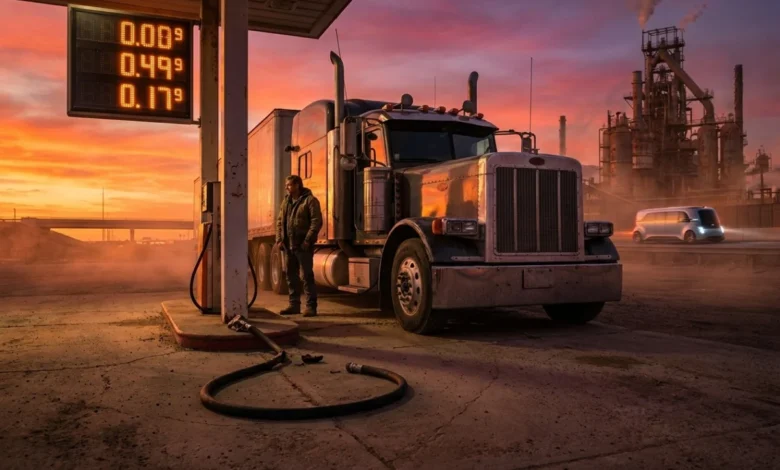
While price spikes are visible, the risk of regional scarcity—physical shortages at the pump—poses a more immediate threat to the continuity of the supply chain. In regions where demand exceeds local refining output, truck stops have begun to report intermittent outages. In parts of California, some retailers have resorted to programming their pumps to a maximum display price of $9.99; in several instances, this is a functional signal to the logistics industry that the station has run out of product entirely.
The implications of these shortages are not limited to the trucking industry. A stalled fleet means a stalled supply chain. When trucks cannot secure fuel, the "just-in-time" inventory systems utilized by major retailers face immediate disruption, leading to the empty shelves observed in various markets. This phenomenon, if it persists, threatens to turn localized fuel shortages into broader economic bottlenecks.
Technological Disruption: The Rise of Autonomous Freight
While diesel prices and supply shortages represent cyclical crises, the advent of autonomous trucking represents a structural shift that could permanently alter the labor market. The rapid development of Level 4 and Level 5 autonomous driving systems by major technology firms and traditional automotive manufacturers is no longer speculative. These platforms are currently undergoing testing on interstate corridors, and the influx of venture capital into the sector suggests a rapid acceleration toward commercialization.
The autonomous model offers several efficiencies that challenge the traditional owner-operator business model. Autonomous rigs are not subject to the same federally mandated hours-of-service (HOS) restrictions as human drivers, allowing for 24/7 operation and increased asset utilization. Furthermore, the push toward electric autonomous vehicles (EVs) creates a long-term hedge against diesel price volatility, potentially marginalizing the independent operators who rely on fossil-fuel-burning internal combustion engines.
Industry experts suggest that this transition will lead to significant consolidation. Larger freight companies with the capital to invest in autonomous fleets and the necessary charging infrastructure will likely gain a competitive advantage, potentially driving smaller, independent firms out of the market. This shift poses a threat to the current composition of the trucking workforce, which has historically been a significant source of independent, middle-class employment.
Official Responses and Industry Outlook
Regulatory bodies, including the Department of Energy (DOE) and the Department of Transportation (DOT), have acknowledged the fragility of the supply chain but maintain that the market will eventually stabilize as refineries complete scheduled maintenance and supply routes adjust to global demand. However, industry associations representing independent contractors argue that government policy, including strict environmental mandates and limited investment in domestic refining capacity, has exacerbated the current crisis.
Trucking organizations have highlighted that the "strike" rhetoric currently circulating is an expression of deep-seated concern regarding the long-term sustainability of the profession. Whether these expressions manifest as coordinated national actions or remain localized protests, they signal a critical inflection point for the industry.
Broader Implications and Future Resilience
The convergence of these crises forces a discussion regarding the structural resilience of the American economy. The current reliance on centralized refining and long-haul logistics has demonstrated vulnerabilities that may require a shift toward more decentralized supply chains.
Analysts suggest that long-term stabilization will require a three-pronged approach:
- Energy Infrastructure Investment: Modernizing existing refineries and increasing domestic capacity to reduce reliance on fragile foreign supply chains.
- Labor Transition Planning: Addressing the impact of automation on the workforce through vocational retraining and policy frameworks that ensure a smooth transition for human drivers.
- Logistical Decentralization: Encouraging regionalized production and distribution networks to reduce the mileage required to deliver goods, thereby lowering fuel dependency.
As the country moves into 2027, the trucking industry remains the focal point of these economic challenges. The interplay between energy prices, infrastructure stability, and technological evolution will determine not only the profitability of the logistics sector but also the availability and cost of essential goods for the American public. The period ahead will likely be defined by how effectively these systemic risks are mitigated and whether the nation can maintain its supply chain integrity during this transition.