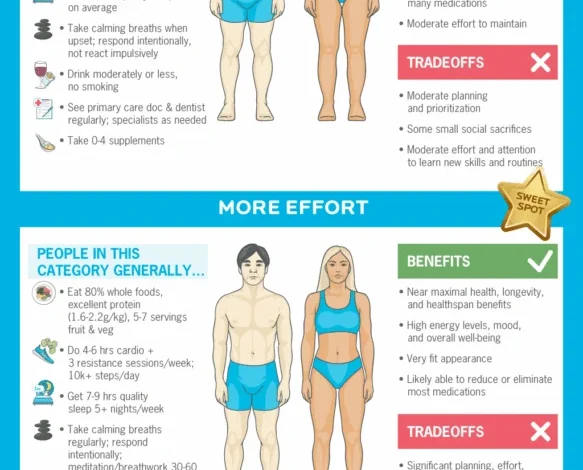
The modern pursuit of longevity has evolved into a high-stakes industry, fueled by a combination of scientific advancement, viral social media trends, and the influence of prominent figures such as Dr. Peter Attia, Dr. Andrew Huberman, and biohacker Bryan Johnson. For many, the goal is no longer just to live longer, but to extend the "healthspan"—the period of life spent in peak physical and mental condition. However, a growing body of evidence suggests that the obsession with "optimizing" human biology through complex, expensive, and time-consuming protocols may be reaching a point of diminishing returns.

The Evolution of Longevity Culture
Over the past decade, the longevity movement has shifted from niche academic research to mainstream culture. This transition was marked by the proliferation of podcasts, wearable health-tracking devices, and an influx of wellness startups promising to "slow the clock." The cultural narrative has largely been driven by the idea that human performance can be engineered through rigorous data collection, specialized supplements, and unconventional therapies like cryotherapy, hyperbaric oxygen chambers, and continuous glucose monitoring for the healthy population.

The psychological appeal of this movement is rooted in the desire for control. By quantifying blood markers, hormone levels, and sleep architecture, individuals feel they can mitigate the uncertainty of aging. Yet, experts in clinical nutrition and exercise physiology increasingly argue that the focus on these high-end interventions distracts from the foundational behaviors that actually dictate health outcomes.

The Myth of Optimization
Data from longitudinal studies and large-scale coaching programs indicate that "optimal" is rarely necessary for the average person to achieve significant health gains. The most profound improvements in mortality risk are consistently linked to basic, non-negotiable habits: adequate sleep, consistent physical activity, a nutrient-dense diet, and social connectivity.

The "optimization trap" often leads to a phenomenon known as the law of diminishing returns. While the first 20 percent of effort in a health journey—such as walking 30 minutes a day or cutting back on ultra-processed foods—yields an 80 percent improvement in health markers, the subsequent "fine-tuning" requires massive investments in time and capital for only marginal biological benefits. Furthermore, extreme protocols can induce chronic stress, potentially offsetting the very health benefits the practitioner is seeking.

Foundational Pillars: Data-Driven Reality
Scientific consensus identifies several non-negotiable pillars of longevity. The challenge, according to public health data, is not a lack of information, but a lack of consistent execution.

1. Exercise as a Physiological Necessity
Research published in journals such as The Lancet underscores that any amount of physical activity reduces all-cause mortality. A landmark study involving 272,550 older adults demonstrated that even low-intensity movement significantly lowers the risk of death from cardiovascular disease and cancer. The most efficient "dose" for exercise appears to be 7.5 to 15 MET-hours per week. Crucially, the combination of resistance training and cardiovascular exercise is superior to either alone, as resistance training maintains bone density and muscle mass—two critical factors in preventing falls and metabolic decline in later years.

2. The Nutritional Spectrum
Dietary advice has become overly convoluted, yet the fundamentals remain straightforward. Large-scale studies involving nearly 10 million participants have linked ultra-processed foods (UPFs) to 32 distinct health harms, including obesity, type 2 diabetes, and cardiovascular disease. Conversely, diets high in whole foods—specifically five daily servings of fruits and vegetables—are associated with a 13 percent lower risk of all-cause mortality. Interestingly, the benefits plateau after five servings, suggesting that while more produce is not harmful, it does not provide an exponential increase in life expectancy.

3. The Sleep-Longevity Link
Sleep is perhaps the most undervalued component of health optimization. Data shows that individuals who consistently achieve 7 to 9 hours of quality sleep live significantly longer than those who do not. Chronic sleep deprivation, defined as consistently getting less than 6 hours, is a primary risk factor for dementia, as deep sleep is essential for the neurological "clearing" of beta-amyloid plaques.

The Trade-offs of Extreme Optimization
When comparing a "medium-effort" lifestyle—one characterized by consistent habits—against an "optimizer" lifestyle—one involving complex, fringe interventions—the disparity in resources is stark. An optimizer may spend three to four times the amount of time and money on health-related tasks, including specialized blood testing, supplement stacks, and restrictive lifestyle modifications.

The societal implications of this are significant. When health becomes a full-time, expensive job, it creates a barrier to entry that excludes the vast majority of the population. Furthermore, "optimization culture" can inadvertently promote orthorexia or exercise addiction. When the pursuit of health becomes an obsession, it often degrades the other domains of "Deep Health," including relational, emotional, and existential well-being. A life spent in pursuit of a "perfect" body often leaves little room for the social connections that are, according to the 87-year-long Harvard Study of Adult Development, the single strongest predictor of long-term life satisfaction and longevity.

Addressing Structural Determinants
It is essential to acknowledge that for many, these recommendations are filtered through the lens of social determinants of health. Poverty, lack of access to safe exercise environments, and systemic health inequalities remain the primary barriers to longevity. Therefore, the focus on individual "optimization" can sometimes act as a blind spot, ignoring the structural changes needed to improve public health on a broader scale.

Future Implications for Public Health
The movement toward "less is more" in the longevity space is gaining traction among medical professionals. Rather than prescribing extreme regimens, the focus is shifting toward "habit stacking"—the integration of small, sustainable behaviors into daily life.

For the average individual, the strategy for longevity is clear:

- Prioritize consistency over intensity: It is better to move your body moderately every day than to train like an athlete for two weeks and burn out.
- Audit your inputs: Focus on whole foods and adequate protein intake, and avoid the temptation to replace whole-food nutrition with complex supplement protocols.
- Manage the "Stress Budget": Treat recovery as an active health behavior, not an afterthought.
- Invest in Relationships: Social health is a biological imperative, not a luxury.
Ultimately, the most effective longevity strategy is one that can be sustained for decades without compromising the quality of the life being lived. While the allure of "cutting-edge" science is understandable, the most robust evidence suggests that the keys to a long, healthy life are not found in a laboratory, but in the mundane, daily commitment to the basics. By turning down the noise of the optimization industry, individuals can reclaim their health, save their resources, and focus on the purpose-driven activities that truly define a life well-lived.