The Profound Simplicity of Upward Salute: Mastering the Fundamentals of Urdhva Hastasana

The seemingly simple posture of Upward Salute, or Urdhva Hastasana, a cornerstone of yoga practice, offers a profound gateway to deeper self-awareness and physical mastery. Originally published in the March-April 2001 issue of Yoga Journal, this archival piece revisits the foundational principles of this ubiquitous pose, highlighting its often-overlooked significance. While many practitioners may unconsciously perform a variation of this pose upon waking, its deliberate and mindful execution in a yoga setting reveals layers of energetic and physical intelligence crucial for advancing one’s practice. By understanding and integrating the subtle nuances of Urdhva Hastasana, yogis can cultivate the power and confidence necessary to explore more challenging asanas, including intricate arm balances and deep backbends.
The Intuitive Awakening: Urdhva Hastasana in Daily Life
For countless individuals, the act of rising from sleep often involves an instinctive, albeit unrefined, version of Upward Salute. The natural inclination to stretch, extend the arms overhead, arch the back slightly, and tilt the head back is an innate response to re-energize the body after a period of rest. This spontaneous movement, driven by an inner imperative to awaken and mobilize, underscores the pose’s fundamental connection to vitality and the circulation of prana, or life force.
However, when encountered within the structured environment of a yoga class, Urdhva Hastasana can be easily underestimated. Beginners, in particular, may find themselves drawn to the perceived challenge and immediate gratification of more complex postures, viewing the simple act of raising the arms as a mere formality. This inclination to prioritize perceived difficulty over foundational understanding can inadvertently create obstacles to accessing the subtler energetic and physical benefits that Urdhva Hastasana meticulously cultivates. The pride derived from mastering outwardly demanding poses can, paradoxically, hinder the development of the deep internal awareness that underpins true yogic progression.
Unlocking Potential: The Strategic Importance of Urdhva Hastasana
The intelligence embedded within Urdhva Hastasana lies in its capacity to serve as a foundational building block for more advanced practices. The principles of alignment, breath integration, and energetic flow introduced in this pose are transferable to a wide spectrum of asanas. Mastering the precise engagement of the feet, the subtle lengthening of the spine, and the coordinated ascent of the arms provides a blueprint for executing complex inversions, powerful standing poses, and challenging backbends with greater stability and awareness.
The pose’s significance extends beyond mere physical preparation. It is a potent practice for cultivating grounding, which is the essential counterpoint to upliftment. The ability to feel rooted through the feet while simultaneously reaching for the sky is a fundamental principle of balance that informs all aspects of yogic endeavor, both on and off the mat. This harmonious interplay of opposing forces—grounding and ascension, effort and ease—is a recurring theme in yogic philosophy and practice, and Urdhva Hastasana offers a clear and accessible entry point to exploring this dynamic.
Deconstructing the Pose: A Three-Part Approach to Urdhva Hastasana
The practice of Urdhva Hastasana, like most yogic postures (asanas), can be effectively understood and refined through a three-part framework: entering the pose, maintaining the pose, and exiting the pose. Adhering to these principles, whether practicing the pose in isolation or as part of a dynamic sequence, ensures a comprehensive and beneficial experience.
1. Entering the Pose: The Physics of Energetic Ascent
A fundamental principle guiding the entry into Urdhva Hastasana, and indeed many yogic movements, is rooted in the physics of action and reaction. In yogic terminology, this translates to the energetic principle that to achieve upward movement, one must first connect with and anchor the energy that moves downward. This concept, often simplified in early physics education as "for every action, there is an equal and opposite reaction," is crucial for understanding the flow of subtle energy within the body.
The practice begins by standing with the feet together, arms resting at the sides. The initial focus is on establishing a profound connection with the earth through the soles of the feet. This involves softening the feet, allowing them to spread naturally, and sensing the even distribution of weight across the entire surface. This grounding is not passive; it is an active engagement with the supportive force of the ground, which in turn facilitates a natural lift upwards through the body.
The breath plays a pivotal role in this initial phase. It should be allowed to flow freely along the full length of the torso, without creating undue distension in the abdomen. With an exhalation, the practitioner consciously softens and releases the weight of the internal organs downward, creating a subtle drawing inward of the navel. This action encourages the organs to rest more fully within the pelvic basin, fostering a sense of firmness in the legs and initiating a subtle upward movement along the spine.
As this grounded energy is established, the practitioner can begin to surrender the shoulders, allowing them to relax away from the ears. The inhalation then becomes the catalyst for raising the arms. The breath is felt across the upper back, facilitating a sense of lightness and length in the arms. This sensation is often likened to the effortless freedom of a child with their arm extended from a moving car window—a graceful extension born from a lack of resistance. In Urdhva Hastasana, this effortless lifting is the outward expression of coordinated inner movement, with all effort emanating from the abdominal center.
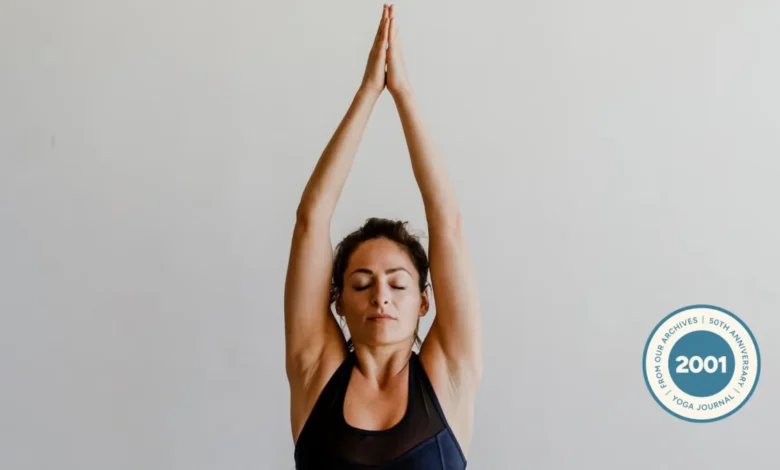
At the apex of the pose, the arms converge overhead, bringing the palms together in a gesture of prayer or union. The shoulder blades are spread, creating space across the upper back, and the chin is drawn slightly inward towards the throat. The head is then gently tilted back, with the gaze directed towards the thumbs. For individuals experiencing neck vertebrae complications, maintaining an upright head position is advised until sufficient strength and understanding are developed to safely perform the backward tilt.
2. Being There: Cultivating Depth and Stability
When Urdhva Hastasana is practiced as a distinct asana, its depth is explored through a continuous process of releasing and softening. The practitioner is encouraged to repeatedly let go or "drop down" the inner body, the shoulders, and the frontal ribs. With sustained practice, this repeated release allows for a deeper awareness of how strength builds from the vital center in the abdomen and how energy rises with unimpeded flow through the back.
During the phase of being in the pose, each exhalation is an opportunity to soften the upper lungs and create increased space around the heart. This energetic expansion fosters a sense of internal release, allowing the ribs to soften and providing greater capacity for the breath. The extension of the neck naturally aligns the spine, straightening it without excessive muscular strain. With each inhalation, the practitioner visualizes the breath entering through the navel, moving in a slow, smooth, and rhythmic pattern. This mindful awareness helps to recenter the practitioner, ensuring that any shifts in weight are met with immediate, subtle adjustments, returning the body to its energetic core.
3. Exiting: The Harmonious Descent
The culmination of Urdhva Hastasana, when all its components are harmoniously integrated, should evoke a profound sense of connection. This state allows the practitioner to tap into the creative force that sustains and fosters growth—a force often described as the union of complementary opposites, or the energy of harmony.
The exit from the pose is initiated with a slow exhalation. The hands, still pressed together, are drawn downward in the Namaste gesture. As the hands approach the face, the proximity and the energetic current they carry are used to gently guide the face downward until the head returns to a neutral position.
The descent of the hands continues, moving together past the throat, the heart, the solar plexus, the navel, and finally the genitals. As this energy moves down the front of the body, the practitioner is encouraged to feel the stillness and lightness in the spine. Closing the eyes at this stage allows for a deeper sense of calm to resonate from the innermost corners of awareness.
The Sutra Metaphor: Precision and Revelation
The ancient yogic texts, particularly the Yoga Sutras of Patanjali, offer invaluable guidance on cultivating the appropriate attitude for practice. The term "sutra" itself, meaning "thread," signifies the absolute minimum necessary to hold a concept together. This brevity was historically intended to facilitate memorization and encourage elaboration through dialogue and sustained personal practice. While seemingly simple on the surface, sutras often possess layers of meaning, encompassing both literal and esoteric interpretations.
The metaphor of a sutra is highly applicable to the practice of Urdhva Hastasana. This pose, like a sutra, requires a resolution of literal and hidden forces. The less one elaborates or overcomplicates the execution, the more the pose reveals its profound depths. The power lies not in excessive effort or intricate embellishment, but in the precise and mindful integration of its fundamental elements.
Broader Implications: From the Mat to the World
The principles embodied in Urdhva Hastasana have implications that extend far beyond the physical practice of yoga. The ability to ground oneself while reaching for higher aspirations, to integrate opposing forces with grace, and to find strength in stillness are valuable life skills. In a world often characterized by rapid change and constant demands, the capacity to maintain inner equilibrium, fostered by practices like mastering Upward Salute, can lead to greater resilience, clarity, and a more harmonious existence.
The historical context of Yoga Journal’s archival series underscores the enduring relevance of foundational yogic teachings. The March-April 2001 publication date places this article within a period of increasing global interest in yoga, where the importance of understanding the roots of practice was paramount. Even today, as yoga continues to evolve and diversify, the emphasis on mastering fundamental poses like Urdhva Hastasana remains a critical component for both new and experienced practitioners seeking a truly transformative experience. The pose serves as a constant reminder that true progress often emerges from a deep and respectful engagement with the basics.