The Profound Power of Upward Salute: Mastering the Subtle Intelligence of Urdhva Hastasana

The simple act of reaching upwards, a movement deeply ingrained in our daily routines, holds profound significance within the ancient practice of yoga. Urdhva Hastasana, or Upward Salute, often dismissed as a foundational pose, is in fact a gateway to deeper understanding and advanced practice. This article, originally published in the March-April 2001 issue of Yoga Journal, delves into the intricate mechanics and subtle energies that unlock the true potential of this seemingly elementary posture, revealing its capacity to build power, confidence, and a profound connection to the body’s inherent intelligence.
For many practitioners, Urdhva Hastasana is an unconscious reflex, the body’s natural inclination to stretch and awaken upon rising. This intuitive movement, often accompanied by a yawn and a gentle arch of the spine, serves to energize the body after a period of rest. However, within the structured environment of a yoga class, beginners may overlook this pose, eager to progress to more complex asanas. This tendency to prioritize perceived difficulty over foundational mastery can inadvertently create obstacles to truly connecting with the subtle, yet powerful, qualities embedded within each posture.
The intelligence of Urdhva Hastasana lies not in its apparent simplicity, but in its capacity to cultivate a sophisticated awareness of energetic principles. By mastering this pose, practitioners can build a robust foundation of power and confidence, essential for navigating the more demanding postures that lie ahead. Furthermore, Urdhva Hastasana contains the seeds of advanced asanas, including intricate arm balances and deep backbends, highlighting its foundational importance in the yogic journey.
The Foundational Principles of Urdhva Hastasana
The practice of Urdhva Hastasana, like most yoga asanas, can be understood through three distinct phases: entering the pose, maintaining the pose, and exiting the pose. Approaching each stage with deliberate awareness, whether practicing the pose in isolation or as part of a dynamic flow, is crucial for unlocking its full benefits.
Entering the Pose: Grounding and Ascent
The genesis of movement within any asana is rooted in a fundamental principle of physics: for every action, there is an equal and opposite reaction. In the context of yoga, this translates to the energetic interplay within the body. To achieve an upward movement, one must first connect with the energy that grounds and stabilizes.
The practice begins with standing in Tadasana (Mountain Pose), feet together, arms at the sides. The initial focus is on the soles of the feet, feeling their connection to the earth and the even distribution of weight. This grounding sensation creates a reciprocal lift, an inherent upward momentum. The breath plays a vital role in this process. It should move freely along the full length of the torso, without distending the abdomen. On an exhalation, a gentle softening and release of the internal organs downwards is encouraged, allowing the navel to draw slightly inward. This sensation of the organs resting on the pelvic floor, coupled with the firming of the legs, initiates a subtle upward energy along the spine.
As this grounded energy is established, the shoulders are surrendered, and the inhalation begins. The breath moves across the back as the arms are raised, instilling a sense of lightness and extension. This effortless lifting is akin to the feeling of a child extending their arm from a moving car, experiencing the air’s resistance and support. This grace, the outward expression of coordinated inner energy, emanates from the abdominal center.
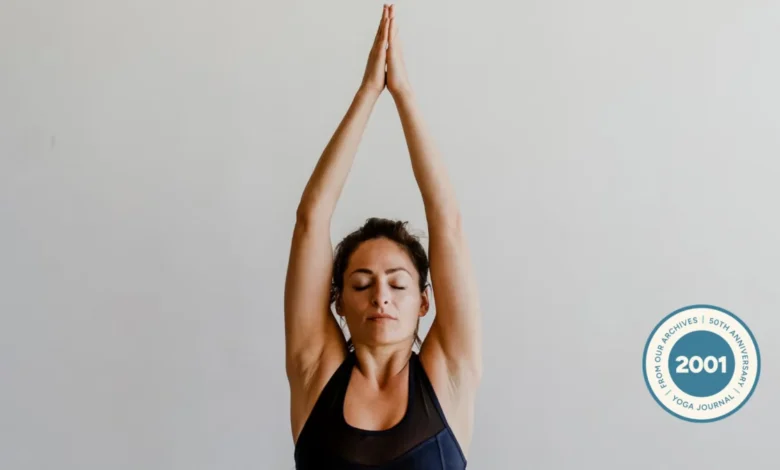
At the apex of the pose, the arms converge overhead, palms meeting. The shoulder blades are spread, and the chin is drawn slightly towards the throat, allowing the head to tilt back gently, gazing towards the thumbs. For individuals with cervical spine sensitivities, maintaining an upright head position is recommended until sufficient strength and understanding are developed.
Maintaining the Pose: Cultivating Inner Space and Stability
Once established in Urdhva Hastasana, the depth of the pose is explored through repeated sensations of inner release. This involves consciously letting go of tension in the inner body, the shoulders, and the frontal rib cage. Through consistent practice, practitioners begin to discern how strength and energy rise vertically through the back, originating from the vital center of the abdomen.
On each exhalation within the pose, the practitioner is encouraged to soften the upper lungs, thereby increasing the space around the heart. This expansion creates a downward sensation in the inner body and a softening of the ribs, facilitating deeper, more expansive breaths. The extension in the neck is enhanced, and the spine naturally lengthens without undue muscular strain. The inhalation is visualized as entering through the navel, moving in a slow, smooth, and rhythmic manner. Any shift in weight that pulls the practitioner away from their center requires attentive readjustment.
Exiting the Pose: Harmonious Descent
The culmination of Urdhva Hastasana, when all the body’s components are harmoniously integrated, fosters a profound sense of connection. This state allows for an attunement with the creative force that governs growth and manifestation – the energy of harmony, born from the union of complementary opposites.
The exit from the pose is a slow, deliberate exhalation. The hands, still pressed together in Namaste, are drawn downwards. As the hands approach the face, their proximity and the subtle energy they generate draw the face downwards until the head returns to a neutral position.
The descent of the hands continues, tracing a path down the front of the body. The energy is felt as the hands pass the throat, the heart, the solar plexus, the navel, and finally the genitals. This downward movement of energy is accompanied by a palpable stillness and lightness in the spine. Closing the eyes at this point allows for the calm to resonate throughout the practitioner’s awareness.
The Sutra Metaphor: Unveiling Deeper Meanings
The wisdom of the Yoga Sutras offers invaluable guidance for cultivating the appropriate attitude towards practice. The term "sutra" itself, meaning "thread," signifies the concise essence of a concept, designed for memorization and elaboration through discourse and sustained personal practice. While appearing simple on the surface, these sutras possess layered meanings, encompassing both literal and esoteric interpretations.
This metaphor of the sutra serves as a powerful lens through which to approach Urdhva Hastasana. It is a posture that demands the resolution of literal and hidden forces. The less one elaborates or overcomplicates the physical execution, the more its profound revelations emerge. This principle of minimal elaboration leading to maximum insight is a testament to the subtle power of this fundamental pose.
Historical Context and Evolution of Urdhva Hastasana
The practice of yoga, with its roots stretching back thousands of years, has seen countless iterations and interpretations of its core postures. Urdhva Hastasana, as a fundamental standing pose, has likely been an integral part of yogic traditions for centuries, evolving alongside the broader philosophical and physical practices. Its inclusion in early yoga texts and its consistent presence in modern yoga sequences underscore its enduring significance.
The March-April 2001 issue of Yoga Journal, where this article was originally published, represented a period of significant growth and dissemination of yoga practices in the Western world. As yoga transitioned from a niche spiritual discipline to a mainstream form of physical and mental wellness, articles like this one played a crucial role in demystifying complex concepts and providing accessible guidance to a growing audience. The publication date of July 17, 2026, suggests a contemporary re-examination and re-publication of this foundational knowledge, indicating its continued relevance and value in today’s yoga landscape.
Supporting Data and Scientific Understanding
While the original article focuses on energetic and subtle body principles, contemporary research offers insights that align with these concepts. Studies on the physiological effects of yoga demonstrate its ability to improve posture, enhance respiratory function, and reduce stress hormone levels. The act of reaching upwards, as in Urdhva Hastasana, can promote spinal elongation, counteracting the effects of prolonged sitting and improving overall musculoskeletal alignment.
Research into the mind-body connection further supports the notion that conscious movement and breathwork can positively influence neural pathways. The focused attention required to maintain grounding while reaching upwards can enhance proprioception (the body’s awareness of its position in space) and interoception (the awareness of internal bodily states). These cognitive benefits contribute to a greater sense of embodiment and control, which are foundational for advanced practice.
Broader Impact and Implications
The mastery of Urdhva Hastasana extends beyond the physical mat. The principles of grounding, upward energy, and coordinated effort cultivated in this pose can be translated into daily life. The ability to stand tall and balanced, to access inner strength when facing challenges, and to move with grace and intention are all valuable life skills.
Furthermore, the pose’s connection to breath awareness and its role in fostering inner calm have significant implications for mental well-being. In an increasingly fast-paced and demanding world, the capacity to pause, ground oneself, and cultivate a sense of presence is invaluable. Urdhva Hastasana, through its elegant simplicity, offers a potent tool for achieving this state of equilibrium.
The continued re-publication and emphasis on foundational poses like Urdhva Hastasana by established platforms such as Yoga Journal signal a growing recognition within the yoga community of the importance of a solid grounding in fundamental principles. This approach not only benefits individual practitioners by fostering deeper understanding and preventing injury but also contributes to the overall integrity and depth of yoga practice as it continues to evolve and reach a wider global audience. The subtle power of the Upward Salute serves as a timeless reminder that the most profound journeys often begin with the simplest of steps.