New Study Reveals Critical Distinction Between Dietary Nitrates and Nitrites in Colorectal Cancer Risk

A landmark longitudinal study conducted by researchers at the Karolinska Institutet has provided significant new clarity regarding the relationship between dietary compounds and colorectal cancer. By tracking 82,009 middle-aged and older adults across two long-running Swedish cohorts, the study—which analyzed data from 1998 through 2022—has effectively decoupled the health reputations of naturally occurring nitrates found in vegetables from synthetic nitrites commonly used as additives in processed meats. The findings suggest that while nitrites are linked to a heightened risk of colorectal cancer in men, nitrates from plant sources present no such danger, potentially reshaping dietary guidelines for long-term health.
The Scope of the Longitudinal Investigation
The research project spanned over two decades, offering a robust statistical foundation for its conclusions. During the 24-year follow-up period, 3,170 participants were diagnosed with colorectal cancer. By linking detailed food and water intake records with national cancer registries, the researchers were able to isolate the effects of specific dietary compounds. The results revealed a stark disparity: nitrate intake showed no statistically significant association with colorectal cancer risk. In contrast, nitrite intake presented a clear, quantifiable danger. Men within the highest quintile of nitrite consumption faced a 23% increased risk of developing colorectal cancer compared to those in the lowest quintile. Furthermore, when focusing specifically on the distal colon—the section of the large intestine closest to the rectum—the risk increased by 50% in men. Interestingly, this pattern did not emerge in women, a finding that has prompted researchers to call for further investigation into potential hormonal, metabolic, or behavioral variables.
Understanding the Chemistry: Why Context Matters
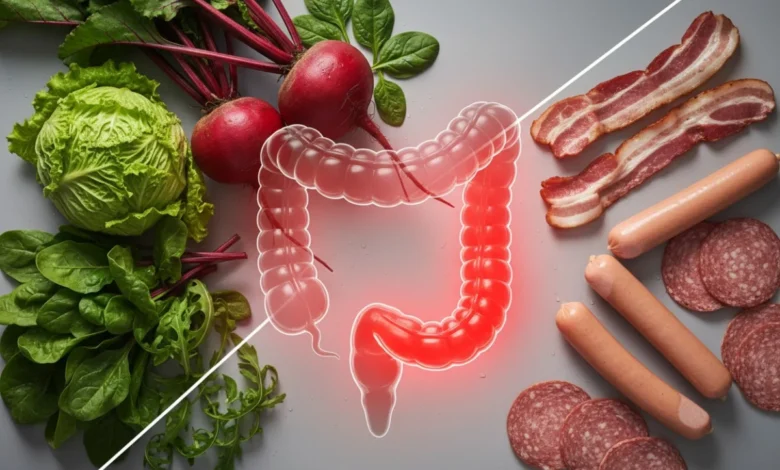
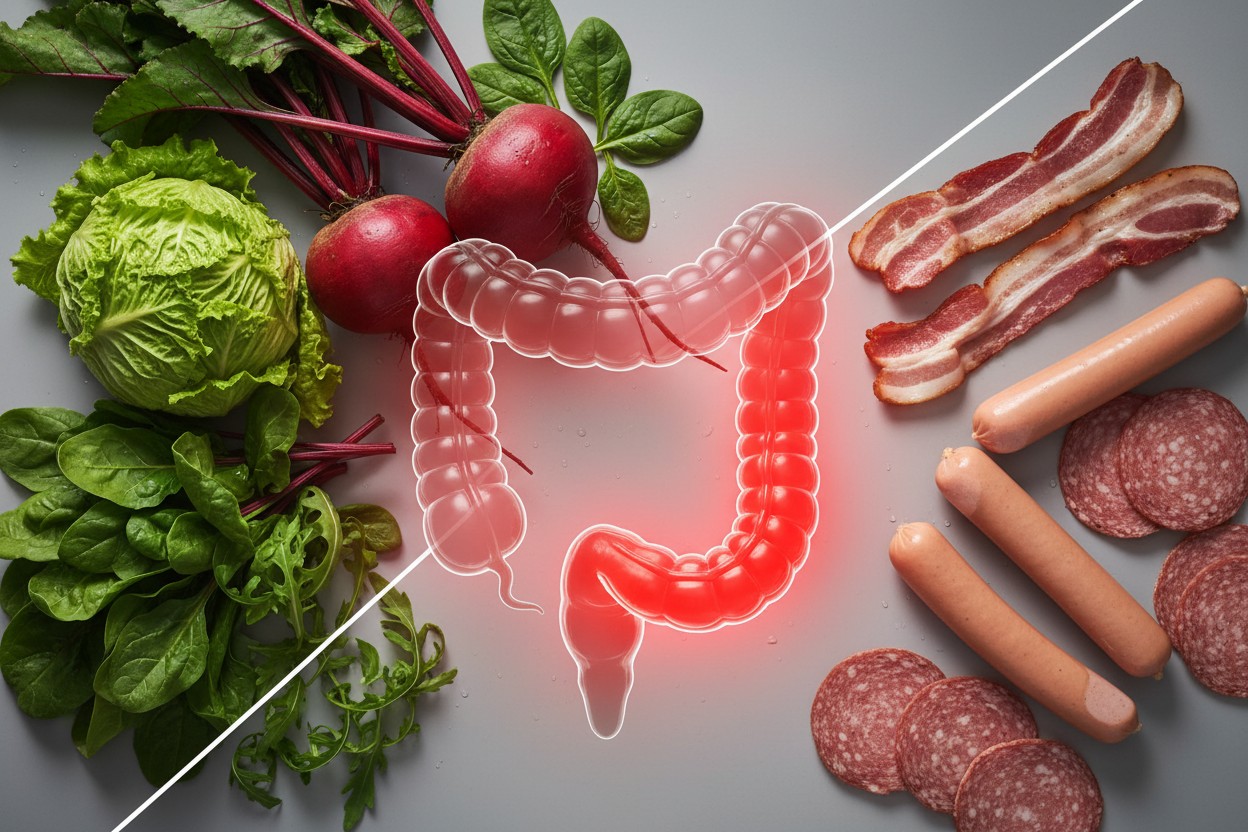
To understand these findings, one must distinguish between the chemical environments in which these compounds exist. Nitrates occur naturally in soil and are absorbed by leafy greens, beets, and other vegetables. These plants are nutrient-dense, containing high levels of vitamin C, polyphenols, and dietary fiber. According to the research, these protective compounds act as a chemical buffer, preventing the formation of N-nitroso compounds, which are known carcinogens.
Nitrites, however, operate in a different context. Primarily introduced to the human diet as additives in processed meats such as bacon, hot dogs, deli meats, and certain plant-based alternatives, they are used to inhibit bacterial growth and maintain an appealing pink color. In the absence of the protective nutrients found in whole vegetables, nitrites are more likely to undergo a "nitrosation" process in the gut, converting into harmful N-nitroso compounds. This transformation highlights the importance of the food matrix—the "package" in which a nutrient arrives—rather than just the isolated chemical itself.
Chronology of Evidence and Global Health Consensus
The Karolinska Institutet study arrives at a time of growing concern among global health organizations regarding the consumption of processed meats. The World Health Organization (WHO), through its International Agency for Research on Cancer (IARC), has already classified processed meat as a Group 1 carcinogen. This classification is based on decades of epidemiological evidence suggesting that the daily consumption of just 50 grams of processed meat increases the risk of colorectal cancer by approximately 18%.
The timeline of this scientific understanding has been steady:
- 1970s–1980s: Toxicology studies first identify nitrosamines as potent carcinogens in laboratory models.
- 2015: The IARC officially classifies processed meat as a proven human carcinogen, noting the role of curing agents.
- 2020–2022: Advanced data modeling from Swedish cohorts refines the understanding of how these substances interact specifically with the anatomy of the colon.
- 2026: New findings from Karolinska Institutet confirm the link between nitrite-heavy diets and distal colon cancer, while exonerating nitrate-rich vegetables.
This cumulative body of evidence suggests that the medical community’s focus is shifting from broad dietary warnings toward more nuanced, source-specific recommendations.
Gender Disparities and Biological Factors
The fact that the Karolinska Institutet study identified a risk in men but not in women remains a focal point for future research. Scientists have proposed several hypotheses to explain this gender split. One potential factor is the difference in total processed meat consumption between sexes, which remains statistically significant in many Western populations. Another possibility involves hormonal differences; estrogen and other hormones may influence how the gut microbiome handles the processing of N-nitroso compounds. Additionally, the study noted that differences in gut transit time and anatomical variations in the colon could contribute to the localized effect observed in the distal colon. Until these mechanisms are fully mapped, the findings serve as a potent reminder that biological sex can play a definitive role in how the body processes dietary carcinogens.
Implications for Public Health and Dietary Policy
The practical takeaway from this study is clear: consumers do not need to fear nitrate-rich vegetables like spinach, lettuce, and arugula. In fact, these foods should remain staples of a healthy diet. The primary target for health intervention is the consumption of processed meats.
For the average individual, reducing the frequency of consuming bacon, ham, sausages, and cured deli meats is the most effective way to lower the intake of exogenous nitrites. For those who choose to consume processed meats occasionally, researchers suggest pairing these items with foods high in vitamin C—such as citrus, bell peppers, or broccoli—as a mitigation strategy. The vitamin C helps to block the chemical transition of nitrites into carcinogenic nitrosamines within the digestive tract.
Public health advocates argue that these findings should influence food industry regulations. As consumers become more aware of the "clean label" movement, there is increased pressure on manufacturers to find alternative preservation methods that do not rely on synthetic curing salts. However, the study also cautions that even some "nitrite-free" products or plant-based meat alternatives that use vegetable-derived powders for curing may still introduce significant levels of nitrites into the diet. Transparency in labeling and a move toward alternative natural preservation technologies are becoming urgent priorities for regulators.
Analysis of the "Nitrate-Nitrite" Paradox
The scientific community has long grappled with the "nitrate-nitrite paradox." While the compounds are chemically related, their impact on human health is diametrically opposed in the context of food sources. Vegetables are beneficial, while processed meats are increasingly identified as a risk factor for tumor development. The Karolinska Institutet study adds a high degree of precision to this debate by confirming that the risk is not inherent to the nitrogen molecule itself, but rather to the food matrix.
This distinction is vital for clinical nutrition. If health professionals were to advise patients to avoid all nitrates, they would inadvertently encourage the avoidance of heart-healthy vegetables that are essential for cardiovascular function. Instead, the current data supports a nuanced approach: advocate for a plant-forward diet while maintaining a strict limitation on processed, salt-cured, and nitrite-preserved animal products.
Conclusion: A Path Toward Informed Consumption
The study’s rigorous methodology—covering over 82,000 participants and 24 years of data—positions it as a definitive piece of evidence in the field of nutritional epidemiology. By isolating the effects of dietary nitrite intake from the broader category of nitrogen-containing compounds, researchers have provided the public with a clear, actionable roadmap for cancer prevention.
As the medical community continues to explore why these effects manifest more prominently in men and within the distal colon, the overarching message remains consistent with existing global health guidance: the quality of the food source is just as important as the nutrient profile. By limiting processed meats and increasing the intake of fresh, nitrate-rich vegetables, individuals can significantly reduce their risk of colorectal cancer. This research underscores that while we cannot change our genetic predisposition or environmental history, we can exert significant control over our long-term health outcomes through the informed selection of what we put on our plates every day. Moving forward, health policy should reflect these findings, encouraging consumers to distinguish clearly between the curing salts in a deli sandwich and the natural nutrients in a bowl of spinach.