The pursuit of longevity: Why the basics of healthy living outperform extreme optimization protocols

In recent years, a cultural shift has transformed the way the general public views aging. No longer content with merely living longer, an increasing number of individuals are seeking to maximize their healthspan—the period of life spent in good health—and are turning to complex, data-driven protocols to fend off age-related decline. This movement, often fueled by influential figures in the biohacking and wellness space, suggests that with enough time, capital, and rigorous adherence to experimental interventions, one can effectively "hack" the aging process to maintain peak physical and cognitive function into their 90s and beyond.

However, a critical analysis of current health data suggests a significant disconnect between the promise of these "optimal" protocols and the reality of human biology. For the vast majority of the population, the pursuit of perfection is not only unnecessary but potentially counterproductive. By examining the intersection of longevity science and long-term health outcomes, it becomes clear that consistency in fundamental behaviors—often overshadowed by the allure of cutting-edge supplements and extreme routines—is the most reliable driver of sustained health.

The Rise of Optimization Culture
The contemporary obsession with "optimizing" human health is driven by a desire for control. Figures such as Dr. Peter Attia, Dr. Andrew Huberman, and biohacker Bryan Johnson have brought longevity into the mainstream, framing health as an engineering project. This content is undeniably compelling; it offers a systematic approach to what has historically been a chaotic and unpredictable aspect of life.

Yet, for those working in public health and professional coaching, the definition of "optimal" is rarely synonymous with "realistic." The danger of this narrative lies in its elitism and complexity. When longevity advice requires expensive blood work, specialized dietary supplements, and hours of daily tracking, it alienates the average person. Furthermore, internal data from large-scale coaching organizations indicates that the law of diminishing returns is heavily at play: the gap between "doing the basics" and "optimizing for perfection" is massive in terms of effort, but marginal in terms of biological return.

Deconstructing the Myths of Longevity
Several pervasive myths sustain the current obsession with extreme optimization. First is the belief that basic lifestyle habits are insufficient for those seeking to outlive the average life expectancy. Clinical evidence suggests the opposite. The primary reason for premature mortality in the United States is not a lack of access to experimental therapies, but a consistent failure to maintain foundational habits such as adequate sleep, balanced nutrition, and regular movement.

Second is the "more is better" fallacy. Whether regarding exercise volume or caloric restriction, there is a distinct U-shaped curve in health outcomes. Pushing past a certain threshold of intensity can lead to overtraining, endocrine disruption, and chronic inflammation. Data reveals that health benefits plateau once an individual achieves a baseline of 7.5 to 15 MET-hours of activity per week; increasing intensity beyond this point provides diminishing returns while exponentially increasing the risk of injury.

Finally, there is the myth that cutting-edge strategies—such as expensive supplement stacks—offer significant advantages. Much of the research touted by wellness influencers is derived from observational studies or animal models, which do not translate directly to human longevity. Many of these fringe interventions lack rigorous, long-term safety data, whereas the foundational habits have decades of peer-reviewed validation.

The Foundational Pillars of Longevity
To achieve long-term health, science points toward seven key behaviors that consistently deliver high returns on investment:

- Regular Movement: Physical activity is the most potent intervention for extending lifespan, regardless of genetic predisposition. The goal should be a combination of cardiovascular health and resistance training. Resistance training is particularly critical for older adults, as it mitigates the risk of falls—a leading cause of injury-related mortality—by enhancing bone density and muscle stability.
- Nutritional Quality: The focus should remain on whole, minimally processed foods. Large-scale studies involving nearly 10 million participants have linked ultra-processed food (UPF) consumption to 32 distinct health harms. A diet composed of 70 to 80 percent whole foods provides significant metabolic protection without the rigidity of extreme dietary fads.
- Protein Intake: As we age, protein becomes the most vital macronutrient for preserving lean mass. While the standard minimums are often cited as 0.8g/kg, research suggests that for those aiming to maintain muscle and metabolic health, 1.2g/kg to 1.6g/kg is a more appropriate target.
- Sleep Hygiene: Sleep is the bedrock of physical recovery. Chronic sleep deprivation (less than seven hours) is associated with an 11 percent increased risk of cardiovascular disease and significantly higher rates of cognitive decline and dementia.
- Stress Regulation: Chronic, unmanaged stress is a systemic inflammatory trigger. However, the objective is not to eliminate stress—which is a natural part of human engagement—but to build "recovery capacity." Effective stress management, such as daily mindfulness or deliberate physical recovery, is essential for maintaining systemic equilibrium.
- Social Connection: Longevity research, including the 87-year-long Harvard Study of Adult Development, identifies strong social relationships as the single greatest predictor of life satisfaction and long-term survival. Social isolation carries mortality risks comparable to smoking 15 cigarettes per day.
- Risk Avoidance: This includes the boring but non-negotiable practices: wearing seatbelts, utilizing sun protection, maintaining dental hygiene, and minimizing alcohol consumption. The World Health Organization has noted that there is no "safe" level of alcohol consumption, particularly regarding cancer risk.
The Cost of Optimization
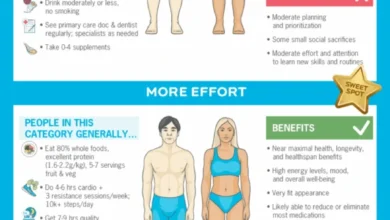
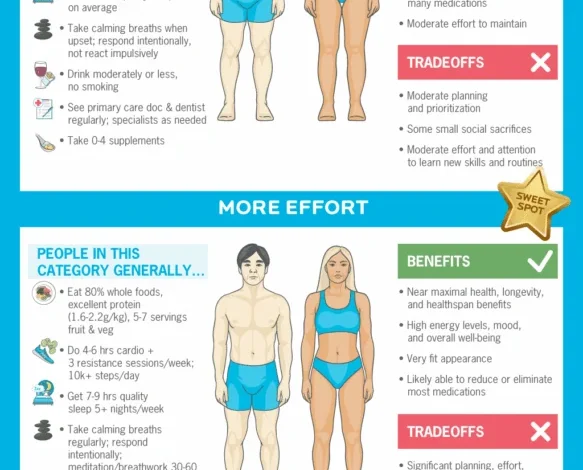
The financial and temporal costs of an "optimizer" lifestyle are substantial. Comparing a standard "healthy" individual with an "optimizer" reveals that the latter may spend three to four times as much time and money for only marginal gains. For many, this level of focus leads to "Deep Health" fragmentation—where the individual becomes physically lean but socially and emotionally isolated.

Optimization can quickly devolve into orthorexia or obsessive-compulsive patterns. The goal of longevity should be to enable a richer, more meaningful life, not to turn life into a series of metrics. When health-promoting behaviors become a source of anxiety, they cease to be health-promoting.

A Realistic Path Forward
For those interested in longevity, the most effective strategy is a structured, sustainable approach to the basics. First, clarify your personal goals: what do you actually want to achieve with your extra years? Second, assess your current consistency. If you are not hitting the basics—sleep, nutrition, movement, and social connection—there is no scientific justification for investing in experimental supplements or therapies.

Finally, tune out the noise. The influencers promoting $10,000-per-year protocols are not authorities on your specific life circumstances. By focusing on the proven pillars of health, the average person can achieve 80 to 90 percent of the longevity benefits available to the wealthiest "optimizers," without sacrificing the quality, joy, and meaning of their daily lives. The evidence is clear: the path to a long life is not found in a pill or an extreme, restrictive protocol, but in the quiet, persistent practice of fundamental human health.
Related posts: