The interconnectedness of global systems, often taken for granted, forms the bedrock of contemporary civilization. However, a growing body of analysis suggests this foundation is more precarious than commonly perceived, with disruptions in critical chokepoints potentially cascading into widespread societal crises. Recent systemic risk assessments highlight the vulnerability inherent in our reliance on narrow logistical corridors, such as the Strait of Hormuz, warning that their interruption could propagate into a civilization-wide emergency, far exceeding historical precedents of societal decline. This analysis posits that the current global crisis is not a distant theoretical concern but an unfolding reality, challenging the widespread assumption that past problem-solving capabilities will inevitably resurface.
The Illusion of Abundance: How Economic Disconnect Threatens Stability
The modern global economy operates on a complex interplay of energy supply, logistical networks, and financial instruments. William Ophuls, in his seminal work "Immoderate Greatness," illuminates how inflation can foster a "money illusion," effectively divorcing economic activity from the ecological realities that sustain it. This illusion, Ophuls argues, is nearing its breaking point. Our contemporary way of life is intrinsically linked to the continuous and unhindered flow of vital resources like oil, natural gas, and containerized goods. The Strait of Hormuz, a critical maritime passage through which a significant portion of global oil supply transits, represents a single point of failure with potentially catastrophic global ramifications. A disruption here could trigger a domino effect, leading to widespread food shortages, pervasive power blackouts, and the disintegration of intricate global supply chains across all continents. For the majority of the population, accustomed to the conveniences derived from uninterrupted imports, the prospect of life without these resources remains largely unimaginable.
The Catastrophic Nature of Infrastructure Collapse
The potential collapse of modern infrastructure is profoundly catastrophic due to a widespread erosion of fundamental survival skills. In an era of automation and specialized expertise, a significant portion of the global population lacks the practical knowledge to perform basic tasks essential for self-sufficiency. Skills such as blacksmithing, maintaining essential water pumps, or operating heavy industrial machinery like steel mills without advanced technological assistance are increasingly rare. Researcher David DuByne warns of converging civilizational cycles culminating in a global cataclysmic shift, where the cascading failures become unstoppable. A prime example of this vulnerability lies in the Haber-Bosch process, the industrial method for producing ammonia that is critical for the synthesis of nitrogen fertilizers. This process underpins the food production for approximately half of the world’s population. Should it cease to function, even temporarily, the resulting fertilizer shortages would directly translate into widespread food shortages, inevitably leading to social unrest and collapse.
Lack of Redundancy and the Speed of Decline
David Holmgren, in his work "Future Scenarios," emphasizes the importance of robust fallback strategies within any functioning civilization. However, the current globalized system, optimized for efficiency, has largely eliminated redundancy. This deliberate reduction in backup systems, while enhancing immediate efficiency, leaves society critically exposed to systemic shocks. Unlike a "good civilizational death," which might be characterized by a slow and manageable decline, the current trajectory suggests a rapid and catastrophic collapse due to this lack of preparedness. The analogy of receding waters preceding a devastating tsunami is apt; the warning signs are present, but the full force of the impending crisis is not yet comprehended by the majority. This is not an exercise in fearmongering, but rather a logical projection derived from an objective analysis of humanity’s deeply embedded dependencies.
Imminent Warning Signs and the Imperative for Preparation

The initial visible indicators of impending societal disruption are likely to manifest as widespread looting of essential goods, particularly in urban centers. As observed in recent interviews with individuals like Matt Bracken, the wholesale emptying of grocery stores and large retail outlets is a probable precursor to broader social breakdown. The confluence of economic instability, engineered food shortages, and overreaching government policies in nations like the United States, for example, is creating a volatile environment ripe for social unrest. The prospect of food riots, fueled by scarcity and desperation, is a tangible concern. Experts and analysts strongly advise that individuals should have essential supplies and practical skills in place before such events unfold, to avoid becoming part of a desperate and potentially dangerous mob.
The personal imperative to acquire practical skills, such as solar installation, water pump maintenance, and basic electrical wiring, is underscored by the understanding that reliance on external experts becomes untenable during a crisis. The window for preparation is rapidly diminishing, as highlighted in previous analyses. Essential preparedness measures include stockpiling non-perishable food items, establishing secure backup communication systems, and acquiring physical precious metals like gold and silver. These metals, as explained by figures like Andy Schectman, president of Miles Franklin, possess intrinsic value that cannot be devalued or counterfeited, making them crucial for trade when fiat currencies collapse.
The Unprecedented Scale of Potential Consequences
The potential consequences of a systemic collapse are staggering. Global hunger alone could result in the deaths of hundreds of millions. However, the cascading failures extending from fertilizer shortages to potential nuclear plant meltdowns could escalate the death toll into the billions. The Haber-Bosch process, as mentioned, supports half the world’s population; its collapse would trigger a humanitarian catastrophe of unprecedented scale. Beyond immediate starvation, a breakdown in global order could usher in an era of warlordism, widespread conflict, and even cannibalism. Regions like the Middle East, potentially rendered uninhabitable by nuclear fallout or the destruction of critical infrastructure like desalination plants, could become focal points for mass displacement and conflict as global power structures reconfigure. Holmgren’s "Future Scenarios" reinforces the point that industrial civilization has failed to dedicate sufficient resources to proactive redesign and mitigation strategies, leaving it profoundly unprepared for such eventualities.
The systemic risk analysis of a hypothetical closure of the Strait of Hormuz unequivocally demonstrates how the modern world order has engineered a "machinery of dependence so extreme that the interruption of one narrow corridor can propagate outward into a general crisis of civilization." This projection is not an exercise in alarmism but a sober assessment of historical patterns of civilizational decay and the interconnected vulnerabilities of our current global system.
The Time to Act is Now: Embracing Self-Reliance
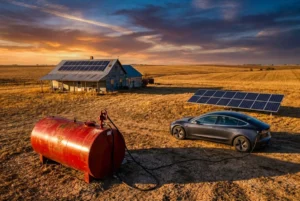
In the face of such potential disruption, self-reliance emerges as the most critical hedge against collapse. Learning practical skills, such as growing one’s own food, and establishing independent power sources like backup generators or solar-powered battery systems are vital components of preparedness. Stockpiling storable food, ensuring robust backup communication methods, and maintaining a reserve of physical gold and silver for trade are equally crucial. Furthermore, in an increasingly surveilled world, decentralized finance and encrypted communication tools can preserve the ability to communicate and organize independently of centralized control grids.
The urgency of the situation cannot be overstated. Decisive action must be taken now, while essential resources are still available and the societal infrastructure remains functional. Staying informed through independent and reliable sources is paramount to understanding the unfolding dynamics. The impending collapse, while a grave concern, is not an insurmountable challenge for those who choose to prepare. The time to act is now, while the shelves are still stocked, the lights are still on, and the existing currency still retains some measure of value. This period represents the last opportunity to build resilience and ensure survival in the face of unprecedented global challenges.