How Much Does Meat Affect Longevity? Measuring Daily Diet Choices Through the Lens of Microlives

The debate surrounding the health implications of red and processed meat consumption has long polarized the scientific community, public health agencies, and consumers. Recent global health data, combined with renewed scrutiny over prominent nutritional studies, has reignited discussions on how dietary habits compound over time to affect human longevity. While public health advisories frequently warn against the dangers of smoking, excessive alcohol consumption, and physical inactivity, comparative public health research suggests that dietary choices—particularly the intake of processed meats like bacon, ham, hot dogs, and sausage—carry cumulative biological costs that rival other well-known lifestyle risks.
To better comprehend these risks on an individual level, researchers have increasingly turned to standardized units of measurement that translate chronic dietary habits into tangible metrics of life expectancy. By examining comprehensive global health assessments, historical controversies in nutritional science, and the mathematical framework of lifestyle metrics, public health advocates are urging a broader reevaluation of what everyday meals mean for long-term survival.
Global Burden and Population-Level Impact
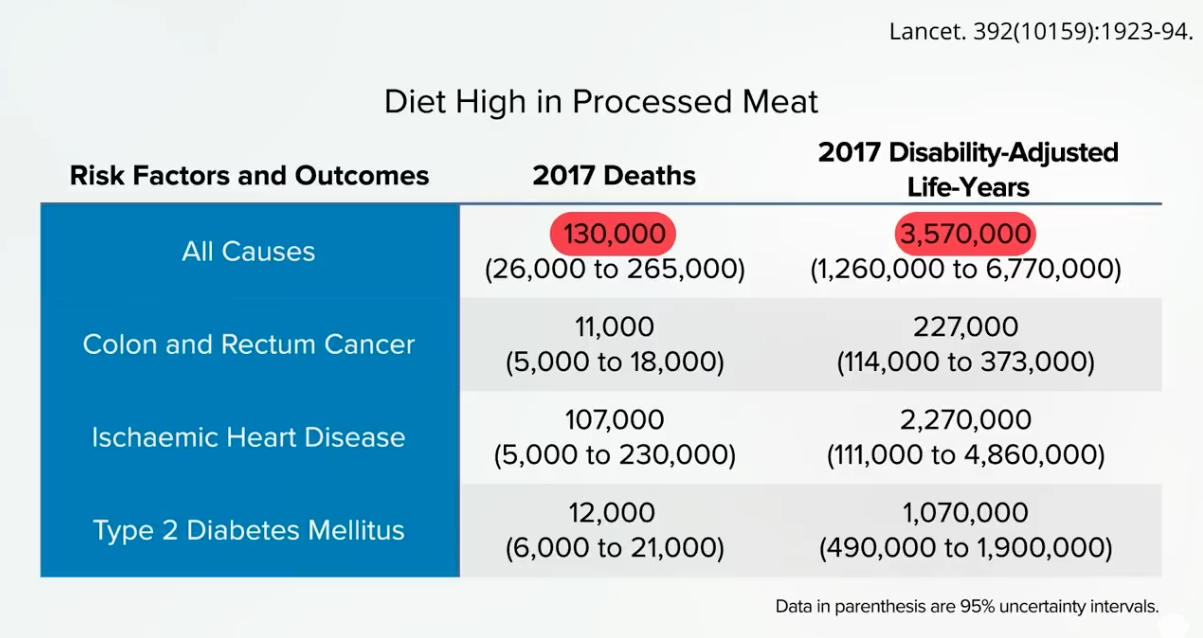
According to comprehensive findings from the Global Burden of Disease Study, diets high in processed meats contribute to more than 100,000 deaths annually worldwide. These fatalities are largely driven by cardiovascular diseases, followed closely by cancers—particularly colorectal cancer—and type 2 diabetes. Consequently, millions of healthy years of life are lost globally each year due to preventable dietary factors.
The scope of this issue extends well beyond international mortality statistics. In the United States, research conducted by organizations such as the Union of Concerned Scientists has modeled the potential outcomes of dietary shifts. Their analyses indicate that if the American population were to reduce processed meat consumption to an average of just one ounce per week, thousands of cancer-related deaths could be averted annually.
Despite these stark population-level projections, translating macro-level statistics into meaningful individual choices remains a persistent challenge for consumers navigating grocery aisles and restaurant menus.
The Scientific Controversy: The Annals of Internal Medicine Debates
The public discourse on meat consumption intensified significantly following the publication of the NutriRECS series of papers in the Annals of Internal Medicine. These papers, which evaluated the health effects of red and processed meat, initially made headlines by suggesting that adults could continue their current levels of consumption without substantial health detriment.

However, the methodology and conclusions of the panels quickly drew sharp rebukes from prominent figures in nutritional epidemiology and public health. Critics pointed out that even the panel’s own underlying analyses indicated that reductions in red and processed meat consumption were associated with a 13 percent lower risk of premature death.
In January 2020, leading nutrition scientists—including the chair of nutrition at the Harvard T.H. Chan School of Public Health—published a critical response highlighting fundamental flaws in the NutriRECS recommendations. They argued that the guidelines suffered from critical methodological limitations and misinterpretations of nutritional evidence. These experts reaffirmed that robust dietary guidelines should continue to emphasize eating patterns low in red and processed meats, while prioritizing minimally processed plant-based foods such as fruits, vegetables, whole grains, nuts, and legumes.
Further compounding these concerns are longitudinal intervention trials, such as Dr. Dean Ornish’s Lifestyle Heart Trial. This landmark research demonstrated that comprehensive lifestyle and plant-based dietary programs could halt or even reverse the progression of severe coronary heart disease. Conversely, control groups that implemented only modest reductions in meat intake—comparable to the modest dietary changes evaluated in the Annals reviews—showed continued physiological worsening of atherosclerosis. Dr. Ornish cautioned the public against misleading nutritional interpretations, emphasizing that rigorous, transparent science remains essential for safeguarding public health.
Quantifying Chronic Risks: The Concept of Microlives
To bridge the gap between abstract statistical risk percentages and daily decision-making, biostatisticians and public health researchers have popularized the concept of the microlife.
While acute hazards—such as skydiving or operating a motorcycle—are frequently measured in micromorts (defined as a one-in-a-million chance of sudden death), chronic lifestyle habits require a different metric. Developed to make ongoing lifestyle factors comparable, a microlife represents exactly 30 minutes of lost or gained life expectancy.
The mathematical derivation of a microlife is rooted in actuarial life expectancy tables. For young adults in their early twenties—such as a 22-year-old man or a 26-year-old woman—remaining life expectancy averages roughly 57 years. This translates to approximately 20,000 days, or 500,000 hours, or one million half-hour increments. A single microlife is therefore defined as the forfeiture of one of those million remaining half-hours.
When applied to lifestyle choices, the microlife framework provides a striking comparative baseline:
- Consuming a pint of strong beer carries an estimated life-expectancy cost roughly equivalent to smoking a single cigarette.
- Being approximately 11 pounds overweight shortens a person’s expected lifespan comparably to maintaining a habit of smoking two cigarettes per day.
- Eating processed meats regularly accumulates significant microlife deficits over time, mirroring the chronic physiological wear associated with other low-level environmental and behavioral hazards.
The Calculus of Longevity: Weighing Risks Against Positive Behaviors
The microlife framework is equally effective at illustrating the cumulative benefits of health-promoting behaviors. Rather than focusing exclusively on dietary restrictions, researchers emphasize the high return on investment offered by incorporating positive lifestyle habits.
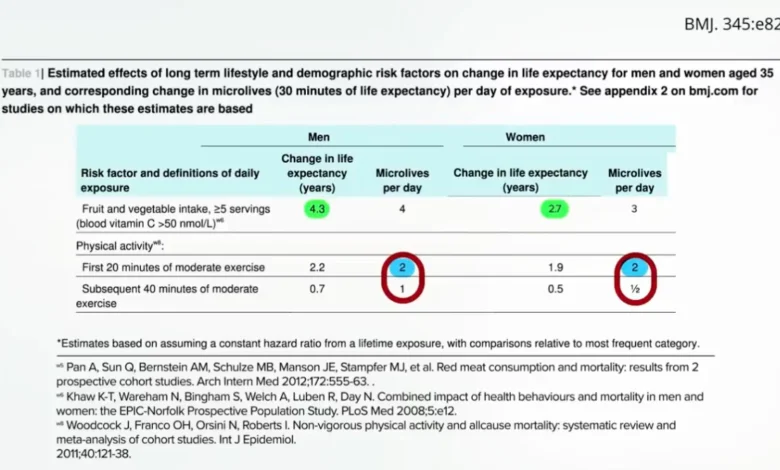
For example, adhering to dietary recommendations that include at least five daily servings of fruits and vegetables is associated with an extension of lifespan averaging up to four years for men and three years for women. This protective effect can be up to twice as beneficial as daily physical activity alone.
However, exercise provides a uniquely immediate return within the microlife model. Data indicates that engaging in approximately 20 minutes of moderate physical activity yields an estimated payback of an extra hour of life—effectively a two-microlife gain for a 20-minute investment. This represents a 3-to-1 return on invested time. While diminishing marginal returns apply to prolonged exercise regimens beyond an hour a day, regular physical movement consistently yields a net positive impact on total longevity.
In direct dietary comparisons, research suggests that consuming a standard hamburger is statistically associated with the loss of approximately one microlife (30 minutes of life expectancy), rendering the longevity cost of a single burger comparable to smoking roughly two cigarettes. When scaled up to processed meats like hot dogs and bacon, the comparative long-term health toll increases further, reinforcing the biological plausibility of choosing plant-based alternatives, such as bean burritos, in daily nutritional routines.
Broader Implications for Public Health Policy
The ongoing dialogue regarding meat consumption and longevity extends far beyond individual dietary choices, influencing institutional food policies, school lunch programs, and global environmental sustainability initiatives. As public health agencies continue to update dietary recommendations, the integration of clear risk-communication tools like microlives and micromorts offers a promising avenue for improving health literacy.
Ultimately, nutrition scientists stress that consumer awareness remains the primary defense against conflicting media reports and industry-sponsored controversies. By aligning daily dietary patterns with robust, peer-reviewed evidence that favors whole plant foods over processed meats, individuals can make informed choices designed to protect both their immediate metabolic health and their long-term longevity.