Unlocking the Anatomy of Uttanasana: A Definitive Retrospective on the Standing Forward Bend


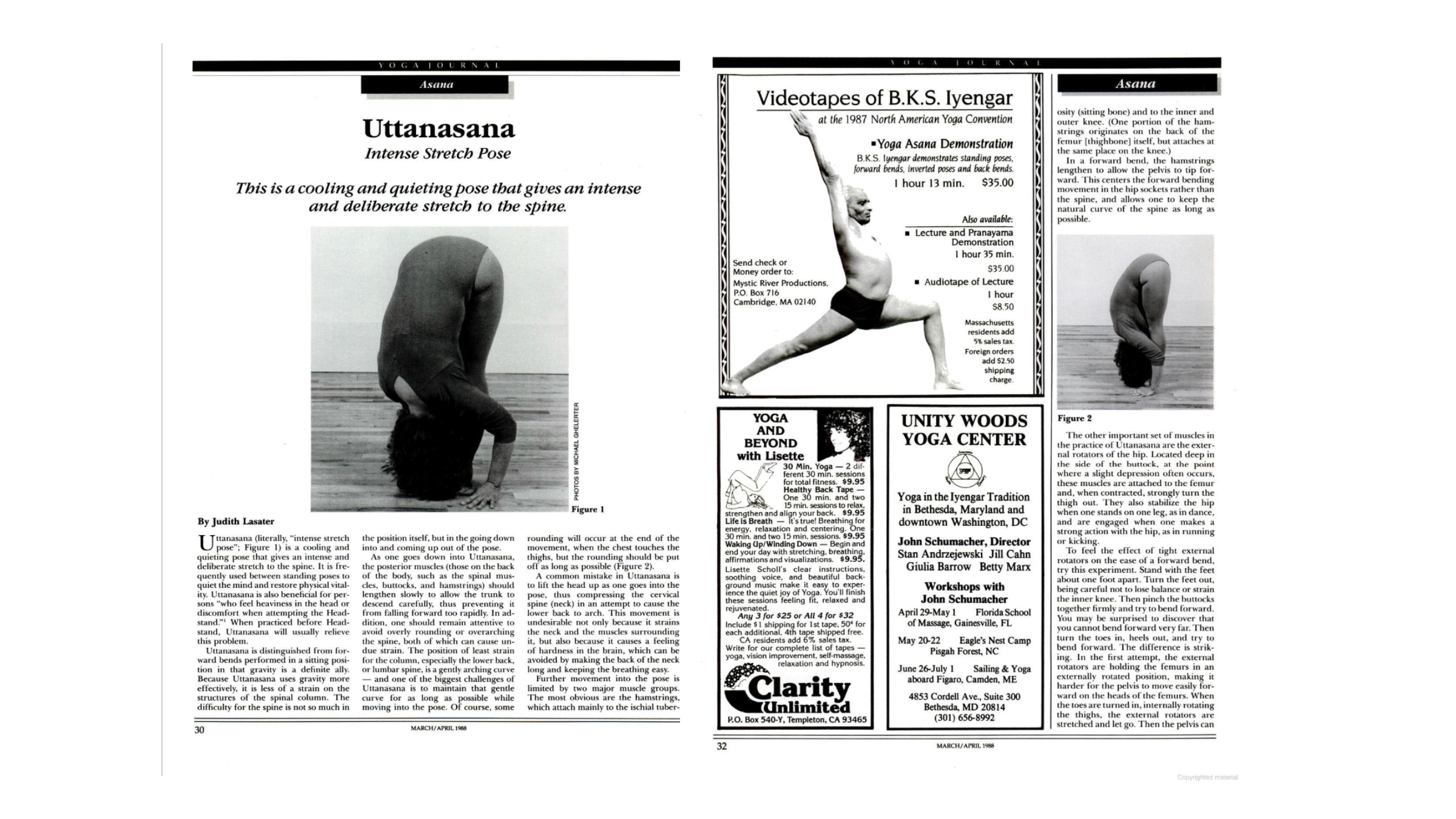
The practice of modern yoga has long maintained a delicate balance between ancient tradition and modern anatomical science, a synthesis prominently displayed in the historical archives of yoga literature. Originally detailed in the March-April 1988 issue of Yoga Journal, the mechanics, structural challenges, and philosophical implications of Uttanasana—commonly known as the Standing Forward Bend—offer a profound masterclass in biomechanics that remains intensely relevant to contemporary practitioners. Defined literally as an "intense stretch pose," Uttanasana has historically served as a cooling, restorative transition between rigorous standing postures, a method for centering an overactive mind, and an essential physical preparation for inversions like the Headstand (Sirsasana). As fitness science and physical therapy continue to validate traditional movement forms, revisiting foundational asanas through both historical and analytical lenses provides modern practitioners with critical insights for injury prevention and structural longevity.
Anatomical Mechanics and the Myth of the Tight Hamstring
For decades, practitioners experiencing limited mobility in forward folds have reflexively blamed their hamstrings, assuming that tight posterior leg muscles are the sole barrier to touching one’s toes. However, historical and biomechanical analyses of Uttanasana reveal a more complex muscular interplay involving the deep external rotators of the hip. Located deep within the lateral gluteal region, these stabilizing muscles—crucial for single-leg balance, running, and athletic agility—frequently dictate pelvic mobility far more than the hamstrings alone.
When the femur is externally rotated, the hip sockets are mechanically restricted, making a clean forward fold from the pelvis nearly impossible. Conversely, internally rotating the thighs by turning the toes slightly inward stretches these deep rotators, instantly releasing the pelvis to tip forward freely over the femoral heads. Furthermore, postures that target and stretch these rotators—such as seated and standing twists, and bound angle pose (Baddha Konasana)—often yield more dramatic improvements in forward-bending capacity than isolated hamstring stretches.
Gravity as an Ally: Navigating the Spinal Column

Unlike seated forward bends where practitioners must fight against gravity to initiate movement from the pelvis, Uttanasana benefits from gravity as a direct mechanical ally. This natural force reduces overall axial compression on the spinal column, provided the descent and ascent are managed with deliberate muscular engagement.
The primary vulnerability in Uttanasana does not lie within the static hold of the posture, but rather during the transitional phases of entering and exiting the shape. As the trunk descends, the posterior muscle groups—including the erector spinae, gluteals, and hamstrings—must lengthen eccentrically to prevent the upper body from collapsing prematurely. Maintaining a neutral, gently arching lumbar curve for as long as possible protects the intervertebral discs from undue shear stress. A common pitfall among novices is lifting the chin to force a lumbar arch, a compensatory movement that compresses the cervical spine, strains the neck muscles, and induces a sensation of cognitive tension or "hardness" in the brain.
Chronology of Practice and Progressive Integration
The historical methodology surrounding Uttanasana outlines a precise chronological framework for mastery, categorizing practitioners from beginners to advanced students based on neuromuscular control and joint mobility.
- Preparation and Entry: Practitioners begin with the feet positioned together or, for those with restricted mobility, spaced in line with the outer edges of the hips. The movement initiates exclusively from the hip sockets upon an exhalation, preserving the natural curves of the spine.
- The Depth of the Fold: Students descend only as far as spinal integrity allows, utilizing props such as yoga blocks, folded blankets, or chairs to bridge the distance if touching the floor requires rounding the lower back.
- The Critical Ascent: Coming up out of the posture presents greater physiological challenge than descending, as the body must work directly against gravity while returning to a vertical orientation. To minimize leverage and protect the lumbar region, practitioners are advised to engage the abdominal muscles and select arm variations appropriate to their experience level—ranging from straight arms at the sides (lowest stress) to arms crossed overhead or extended in line with the ears (highest leverage and strain).
- Stabilization and Blood Pressure Regulation: The ascent must be executed at a moderate, controlled pace during inhalation. Rapid transitions can trigger orthostatic hypotension, particularly in individuals with naturally low blood pressure. Recommendations for such practitioners include staged ascents, pausing halfway to allow the cardiovascular system to adapt and ensure adequate cerebral perfusion.
Expert Insights and Physiological Implications
Physical therapists and biomechanics experts frequently reference the principles embedded in historical asana analysis to address modern musculoskeletal issues, particularly chronic low back pain and postural fatigue. By examining how minor adjustments in foot placement and pelvic rotation alter spinal load, clinicians can better prescribe therapeutic movement patterns.
From a physiological standpoint, the cooling and quieting nature of Uttanasana is directly linked to its classification as a mild inversion. By bringing the head below the heart, the pose alters baroreceptor signaling, slows the heart rate, and activates the parasympathetic nervous system. This physiological shift explains its historical use as a precursor to Headstand: by relieving intra-cranial pressure and teaching the practitioner how to manage gravity without neck compression, Uttanasana prepares the nervous and circulatory systems for more demanding inverted practices.
Mindfulness in Transition: Beyond the Mat
Beyond its clear physical benefits, the historical discourse surrounding Uttanasana elevates the concept of "transition" to a central tenet of mindful movement. Traditional teachings emphasize that the moments of entering and exiting an asana require vastly more concentration than holding the static shape itself. While a stationary posture offers a concrete physical anchor for the wandering mind, transitional phases are characterized purely by fluid movement and breath, leaving ample opportunity for mental distraction.
This structural focus on transitional awareness carries profound implications for daily life. Philosophers and mindfulness practitioners suggest that human existence is fundamentally an unbroken sequence of physical, emotional, and spiritual transitions. By training the mind to remain centered, anchored, and aware during the micro-movements of entering and leaving a yoga posture, individuals cultivate a resilient psychological anchor capable of navigating life’s broader, inevitable changes. Thus, the humble Standing Forward Bend transcends its classification as a mere hamstring stretch, evolving into a comprehensive framework for physical health, neurological regulation, and mindful living.