Navigating the Complexities of Health Optimization: Separating Science from Hype in the Pursuit of Longevity

The universal human desire to live longer, and more importantly, healthier lives, has never been more pronounced. In an era saturated with information, the quest for extended vitality has spawned a colossal industry of advice, products, and protocols, all promising to unlock the secrets to a longer, more vibrant existence. From reversing chronic disease and maintaining a youthful glow to achieving centenarian status or even aspiring to radical life extension, the market for "optimizing" one’s health is booming. However, this proliferation of claims, often disseminated by fitness influencers, authors, and podcasters, raises critical questions about the efficacy, necessity, and true cost—both in terms of effort and finance—of these advanced strategies. This article delves into the current landscape of health and longevity pursuits, examining the scientific underpinnings, the allure of quick fixes, and the sustainable pathways to a life well-lived.
The Modern Landscape of Longevity and Wellness
The pursuit of longevity is not a new phenomenon; ancient civilizations sought elixirs and rituals to prolong life. What distinguishes the contemporary movement is its blend of cutting-edge science, accessible information (and misinformation), and commercial enterprise. Over the past century, global life expectancy has seen a remarkable increase, largely due to advances in sanitation, medicine, and nutrition. According to data from the World Health Organization, global life expectancy at birth increased by over six years between 2000 and 2019, rising from 66.8 years to 73.4 years. While this represents a significant triumph, it has also brought into sharper focus the challenge of "healthspan"—the period of life spent in good health, free from chronic disease and disability. The modern longevity discourse is increasingly shifting from merely adding years to life to adding life to years.
This shift has coincided with the rapid expansion of the global wellness industry, estimated to be worth over $5 trillion, encompassing everything from nutrition and fitness to mental wellness and preventative medicine. Within this vast ecosystem, a segment dedicated to "health optimization" and "biohacking" has gained significant traction. This segment often advocates for ultra-specific, advanced protocols that promise transformative results, ranging from personalized supplement regimens and complex dietary restrictions to intensive exercise programs and experimental therapies. The appeal is understandable: in a world where convenience and immediate gratification are often prized, the promise of an optimized self through targeted interventions can be incredibly enticing.
Distinguishing Lifespan from Healthspan: A Critical Definition
Central to understanding the current dialogue around longevity is the distinction between lifespan and healthspan. Lifespan refers to the total number of years an individual lives. Healthspan, on the other hand, refers to the period of life during which an individual is generally healthy and free from serious disease or disability. While extending lifespan is a primary goal for many, the quality of those additional years is paramount. Living to 100 but spending the last two decades severely debilitated by chronic illness holds less appeal than living to a slightly lesser age with sustained vitality and independence.
The rise of chronic non-communicable diseases (NCDs) such as heart disease, stroke, cancer, diabetes, and chronic respiratory diseases presents a significant challenge to healthspan. These conditions are major causes of premature death and disability globally. The World Health Organization reports that NCDs kill 41 million people each year, equivalent to 74% of all deaths globally. Many of these diseases are largely preventable through healthy lifestyle choices, highlighting the importance of preventative health measures over reactive interventions. This context underscores why the focus on sustainable, evidence-based strategies for maintaining health is increasingly critical, rather than relying solely on advanced, potentially costly, and unproven "optimization" techniques.
The Enduring Wisdom of Core Health Principles
Amidst the clamor of complex health optimization strategies, the foundational pillars of health and longevity remain steadfast and universally accepted by the scientific and medical communities. These principles, often overlooked in the search for novel solutions, form the bedrock upon which any meaningful pursuit of healthspan and lifespan must be built.
- Balanced Nutrition: A diet rich in whole foods, including a variety of fruits, vegetables, lean proteins, and healthy fats, is consistently linked to reduced risk of chronic diseases and increased longevity. Research consistently supports dietary patterns like the Mediterranean diet, known for its emphasis on plant-based foods, healthy fats (like olive oil), and moderate consumption of fish and poultry, as being highly beneficial. Conversely, diets high in processed foods, sugar, and unhealthy fats contribute significantly to inflammation, obesity, and NCDs.
- Regular Physical Activity: Engaging in consistent exercise, encompassing both aerobic and strength training, is crucial for cardiovascular health, bone density, muscle mass maintenance, metabolic function, and mental well-being. The U.S. Department of Health and Human Services recommends at least 150 minutes of moderate-intensity aerobic activity or 75 minutes of vigorous-intensity activity per week, along with muscle-strengthening activities on two or more days a week.
- Adequate Sleep: Sleep is not merely a period of rest but a vital physiological process critical for cellular repair, hormone regulation, cognitive function, and immune system strength. Chronic sleep deprivation is linked to an increased risk of obesity, diabetes, cardiovascular disease, and impaired cognitive performance. Most adults require 7-9 hours of quality sleep per night.
- Stress Management: Chronic stress elevates cortisol levels, leading to systemic inflammation, impaired immune function, and increased risk for various health issues, including heart disease and mental health disorders. Techniques such as mindfulness, meditation, yoga, spending time in nature, and social connection are effective in mitigating the detrimental effects of stress.
- Social Connection: Strong social ties and community engagement are increasingly recognized as powerful determinants of health and longevity. Loneliness and social isolation have been linked to increased risk of premature death, comparable to risk factors like smoking and obesity.
These core tenets, while seemingly simple, represent the most impactful and scientifically validated strategies for promoting health and extending healthy life. They are accessible, often cost-effective, and sustainable for the vast majority of individuals.
Beyond Basics: Unpacking the "Optimize" Mandate
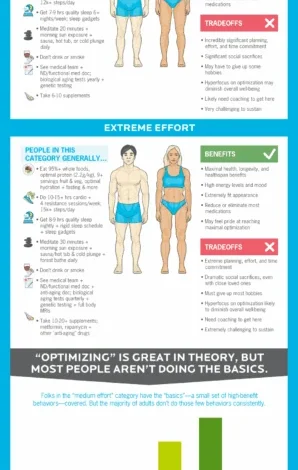
The appeal of "optimization" often stems from a desire to move beyond these fundamental principles, seeking an edge that promises superior results. This can manifest in several ways:
- Ultra-specific dietary regimens: Beyond simply "eating healthy," some protocols advocate for extreme restrictions (e.g., carnivore diets, highly restrictive elimination diets), precise macronutrient timing, or the use of niche superfoods and supplements.
- Advanced diagnostic testing: This includes comprehensive genetic testing, extensive blood panels (far beyond standard medical checks), microbiome analysis, and advanced imaging, often marketed as essential for personalized health strategies.
- Biohacking tools and devices: Wearable tech for continuous glucose monitoring, advanced sleep trackers, infrared saunas, cryotherapy, nootropics, and various energy-boosting devices are promoted as ways to fine-tune bodily functions.
- Experimental therapies: Some individuals explore therapies with limited human research, such as certain stem cell treatments, hormone replacement therapies without clear clinical indication, or specific IV nutrient drips.
Proponents argue that these methods, often backed by anecdotal evidence or preliminary research, can "reverse chronic disease," "extend youthful glow," or even push the boundaries of human longevity significantly beyond what traditional medicine suggests. The language used is often aspirational, focusing on "optimal" rather than merely "healthy," implying a level of performance and resilience unattainable through conventional means.
Weighing the Investment: Monetary and Lifestyle Demands

The critical question, as highlighted by the original article, is whether these ultra-specific, advanced protocols are truly necessary or even effective, and what they demand in terms of effort, time, and money.
- Financial Cost: The monetary investment can be substantial. Genetic testing can cost hundreds to thousands of dollars. Specialized supplements, often sold in bespoke packages, can run into hundreds per month. Advanced diagnostics and consultations with "longevity doctors" or "biohacking coaches" can easily reach thousands annually. Devices like high-end air purifiers, water filters, cryotherapy sessions, or infrared saunas represent significant upfront and ongoing expenses. For example, a single cryotherapy session can cost $50-$100, while a personal infrared sauna can range from $1,500 to $5,000 or more.
- Time and Effort: Adhering to highly restrictive diets, complex supplement schedules, and rigorous, specific exercise routines demands significant time, discipline, and mental bandwidth. Preparing specialized meals, tracking every nutrient, scheduling multiple appointments, and incorporating various "biohacks" can transform health into a full-time project, diverting attention and energy from other aspects of life, such as social engagement, hobbies, or professional pursuits.
- Mental and Emotional Burden: The relentless pursuit of "optimization" can lead to orthorexia (an unhealthy obsession with healthy eating), anxiety about not adhering perfectly to protocols, and a sense of failure if expected results are not achieved. The pressure to constantly monitor, measure, and improve can erode joy and spontaneity, turning health into a source of stress rather than well-being.
The fundamental query then becomes: are the marginal benefits, if any, derived from these intensive efforts truly worth the trade-offs? For many, the answer lies in achieving a balance where health practices enhance life rather than consume it.
The Scientific Consensus: Prudence Over Pseudoscience
The mainstream medical and scientific communities largely advocate for an evidence-based approach that prioritizes proven strategies over speculative ones. Leading institutions like the National Institutes of Health (NIH), the American Heart Association, and the American Medical Association consistently emphasize the critical role of lifestyle factors in preventing disease and promoting longevity.
Medical professionals and registered dietitians frequently express caution regarding unsubstantiated claims and highly restrictive protocols. Dr. Elizabeth Barrett-Connor, a distinguished professor of family medicine and public health, often highlights that "the basic principles of healthy living—eating well, moving more, not smoking, and maintaining a healthy weight—are far more impactful than any specific ‘anti-aging’ supplement or advanced therapy currently available." Public health experts, such as Dr. David Katz, a specialist in preventive medicine, have repeatedly warned against the proliferation of health misinformation online, emphasizing that "the best evidence points to foundational lifestyle factors. Anything beyond that requires rigorous scientific validation, which most ‘optimization’ claims lack."
The consensus is that while research into advanced longevity mechanisms (like senolytics, gene therapies, or caloric restriction mimetics) is promising, these are still largely in experimental stages and not ready for widespread public application. Furthermore, the benefits observed in controlled lab settings or animal models do not always translate directly to humans.
The Imperative of Evidence-Based Decision Making
Making informed decisions about health and longevity requires a critical assessment of the evidence. This involves:
- Seeking credible sources: Prioritizing information from peer-reviewed scientific journals, reputable medical organizations, and certified health professionals.
- Understanding scientific rigor: Recognizing the difference between anecdotal evidence, correlational studies, and randomized controlled trials (RCTs), which provide the strongest evidence of cause and effect.
- Questioning grand claims: Being skeptical of promises of rapid, dramatic, or effortless transformations, especially those that come with a high price tag.
- Consulting healthcare professionals: Discussing any significant dietary changes, supplement use, or advanced protocols with a doctor, dietitian, or other qualified healthcare provider to ensure safety and appropriateness.
The pursuit of health should ideally be guided by a spirit of inquiry and an appreciation for the scientific method, rather than succumbing to the allure of marketing hype or the fear of missing out on a supposed "secret" to eternal youth.
Broader Repercussions: Health Equity and Mental Wellness
The proliferation of high-cost, advanced optimization protocols also has broader societal implications:
- Health Equity: The emphasis on expensive, niche interventions can exacerbate health disparities, making the pursuit of "optimal" health an exclusive domain of the affluent. This diverts attention and resources from addressing the fundamental determinants of health—such as access to nutritious food, safe environments, and quality healthcare—which disproportionately affect underserved communities.
- Mental Wellness: The constant pressure to optimize every aspect of one’s health can contribute to anxiety, body image issues, and a sense of inadequacy. The notion of "perfect health" can become an unattainable ideal, leading to chronic dissatisfaction rather than genuine well-being. This aligns with a broader societal trend of striving for perfection fueled by social media, where curated images of health and vitality can create unrealistic expectations.
Towards Sustainable Longevity: A Balanced Approach
Ultimately, the journey towards a longer, healthier life need not be a financial drain or a relentless struggle. The most impactful strategies are often the most accessible and sustainable. Embracing the foundational principles of nutrition, exercise, sleep, stress management, and social connection provides the vast majority of health benefits. For those interested in exploring beyond these basics, a cautious, evidence-based approach is paramount, prioritizing safety, efficacy, and genuine improvements in quality of life over the pursuit of unproven extremes.
The goal should be to integrate health-promoting habits seamlessly into a life that is enjoyable and fulfilling, rather than allowing the pursuit of health to overshadow the joy of living itself. By seeking clarity through credible information and making choices that align with personal values and scientific evidence, individuals can confidently navigate the complex world of health and longevity, ultimately achieving a life that is both long and truly lived.
The journey to optimal health is not a sprint, but a marathon—one best run with sustainable practices, informed choices, and a healthy dose of skepticism towards claims that promise the moon for a hefty price. The true cost of optimal health, it turns out, is not necessarily measured in dollars spent on exotic supplements or advanced diagnostics, but in the wisdom to discern genuine well-being from fleeting fads, and the discipline to consistently embrace the simple, yet profound, habits that truly make a difference.